1. Why Egypt Is a Standout Noodle Market
Egypt combines features that rarely sit in one market. It is one of the largest population centers in Africa and the Arab world, with a young, urbanizing consumer base and a food culture built around affordable staples. Instant noodles fit that pattern perfectly: a low-cost, quick meal that scales with an integrating middle class.
Three forces make Egypt compelling for new production:
- Scale of demand: a population measured in the tens of millions concentrated along the Nile corridor means dense logistics, concentrated distribution, and strong retail reach from a single factory.
- Halal as the baseline: Egypt is a Muslim-majority market, which means halal compliance is not an optional premium feature but the default standard — and the same certification unlocks export into the wider Arab, North African, and GCC markets.
- Strategic geography: Egypt sits at the crossroads of Africa and the Middle East, connected to Europe. A factory here can serve domestic demand while positioning for neighbouring export corridors.
GYOUNG already exports to Egypt, so this is a market with a proven track record for our equipment — not an assumption built on an untested territory.
2. The Demand & Positioning Picture
Egyptian consumers are price-sensitive and value-conscious — the market rewards operators who can deliver a consistent, affordable product at scale rather than chase premium positioning. The winning formula is high uptime, low cost per pack, and reliable supply, not exotic differentiation.
| Dimension | Egypt Profile |
|---|---|
| Market character | Large, price-sensitive, habitual staple demand |
| Winning lever | Cost per pack, energy efficiency, production uptime |
| Compliance | Halal baseline + food-safety and labeling standards |
| Strategic upside | Bridge to North Africa, GCC, and the wider Arab market |
For an investor, Egypt behaves like a volume and efficiency play: build a disciplined operation that can produce profitably at a competitive retail price, and the market's scale does the heavy lifting on volume. That is distinct from the "highest-margin" play in South Africa or the "compliance-first premium" play in the GCC.
3. Cost Structure & Investment Picture
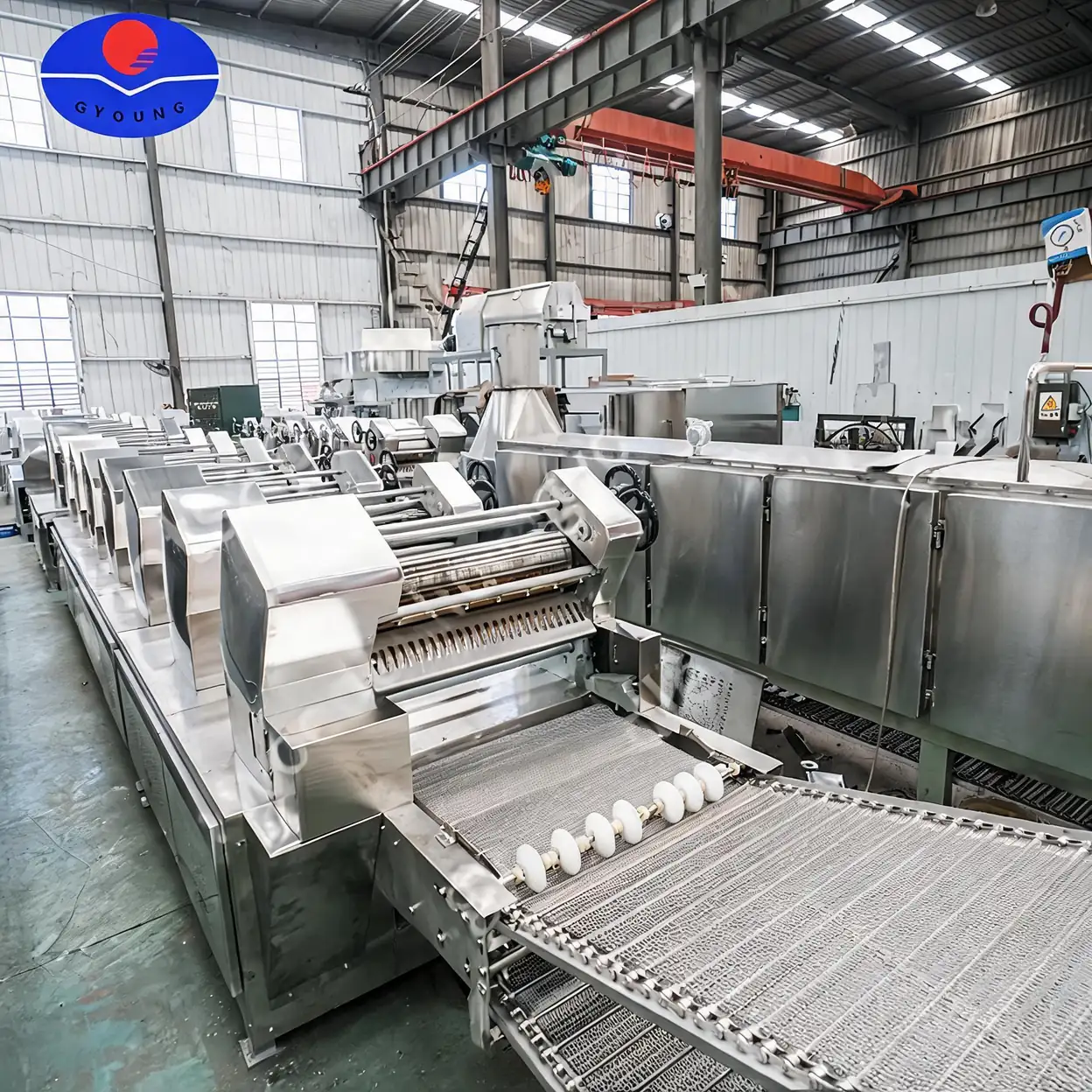
The equipment entry point is the same proven GYOUNG line-up we run across emerging markets. An entry-level fried instant noodle line starts around $92,000–$96,000 FOB (excluding packaging machine), producing 30,000 packs per 8-hour shift with 2–3 operators on a recommended plant footprint of about 15m × 40m. Configurations scale up to 300,000 packs per shift. A complete line including automatic packaging starts from USD 100,000 (30,000 packs/8h).
For a realistic full-cycle plan:
- Manufacturing: about 3 months (90 days)
- Sea freight to Egyptian ports such as Alexandria or Damietta: about 30–45 days
- Installation & commissioning: at least 1 month
- Total (order → first production): roughly 7 months
As with every instant noodle operation, flour and frying oil dominate the per-pack cost, with seasoning, packaging, labor, and energy following. Egypt's position as a large wheat importer means flour sourcing should be modeled carefully — a meaningful part of your operating plan is locking in a stable, cost-competitive flour supply rather than treating it as a given.
4. Halal, Certification & Compliance for Egypt
In a Muslim-majority market, compliance is the entry ticket, not a differentiator.
- Halal certification requires both halal ingredients and a halal-auditable production process. A line built from 304 food-grade stainless steel with cleanable, traceable surfaces makes certification straightforward and positions the factory for export.
- CE and ISO 9001 remain the baseline international quality signals Egyptian importers and distributors expect in industrial equipment.
- Labeling & food safety: meet local food-labeling and food-safety requirements, including the halal mark and Arabic-language labeling where required.
GYOUNG lines use 304 stainless steel contact surfaces and ship with CE and ISO 9001 certification, which supports both halal-audit readiness and importer confidence across the region. We also build in low-energy, generator-friendly designs that fit markets where grid supply can be variable.
5. Is Egypt the Right Fit for Your Project?
Egypt suits a specific, well-defined investor profile.
It suits you well if you:
- Want to serve a large, price-sensitive, structurally resilient consumer market rather than a frontier bet
- See halal certification as a strategic baseline that opens Egypt, North Africa, and the GCC from one factory
- Can compete on cost per pack, energy efficiency, and uptime — the levers that win in a value-conscious market
- Value proven local demand over greenfield market education
It requires more caution if you:
- Expect blue-ocean margins — Egypt is competitive and price-sensitive, so unit economics must be modeled honestly, starting with flour supply
- Are new to halal compliance and local food-safety labeling — these add setup time and cost that must be factored in from day one
Net net: Egypt rewards a cost-disciplined, compliance-aware operator with one of the largest built-in noodle demands in the region — a volume-and-efficiency profile distinct from the frontier margins of West Africa or the premium compliance of the GCC.
Frequently Asked Questions
Is Egypt a good market for instant noodle manufacturing?
Yes — Egypt is a large, price-sensitive, Muslim-majority market with dense urban demand and a food culture built around affordable staples. It rewards a cost-disciplined, high-uptime operation and offers a strategic bridge to North Africa, the GCC, and the wider Arab market through halal certification.
How much does an instant noodle production line cost for Egypt?
An entry-level fried instant noodle line starts around $92,000–$96,000 FOB (excluding packaging machine), producing 30,000 packs per 8-hour shift with 2–3 operators. Configurations scale up to 300,000 packs per shift. Add packaging equipment, shipping, installation, and flour-supply setup for the full project budget.
What is needed for halal noodle manufacturing in Egypt?
Halal certification requires both halal ingredients and a halal-auditable production process. A line built from 304 food-grade stainless steel with cleanable, traceable surfaces makes certification straightforward. CE and ISO 9001 are the baseline quality signals importers expect, and labeling must meet local food-safety and Arabic-language requirements where applicable.
How long from order to production for an Egyptian noodle factory?
Plan roughly 7 months in total: about 3 months manufacturing, 30–45 days sea freight to Egyptian ports such as Alexandria, and at least 1 month for installation and commissioning. Halal certification and labeling approvals should run in parallel and be started early.
What are the main costs of making instant noodles in Egypt?
Flour and frying oil dominate the per-pack cost, with seasoning, packaging, labor, and energy following. Egypt is a large wheat importer, so locking in a stable, cost-competitive flour supply should be modeled from day one. A hot, humid climate also makes dehumidified storage and corrosion-resistant 304 stainless steel equipment important.
Planning a noodle production line for Egypt, North Africa, or the wider Arab market?
Contact GYOUNG CHINA for a tailored line configuration, halal-ready equipment guidance, and a factory layout plan matched to your target capacity and market.
📩 Contact UsReferences / Data Sources:
- GYOUNG product & logistics documentation (2026) — line configurations (entry $92,000–$96,000 FOB, 30,000 packs/8h; up to 300,000 packs/8h), 2–3 operators, 15m × 40m recommended plant, and lead times (manufacturing ~90 days, sea freight 30–45 days, installation ≥1 month).
- World Instant Noodles Association (WINA) — regional and per-capita instant noodle consumption context across Africa and the Middle East.
- Egyptian food-labeling & halal certification frameworks — halal and food-safety requirements for the domestic and wider Arab / North African market.
- GYOUNG internal market research — Egypt Instant Noodle Opportunity (Sep 2026) — demand drivers, positioning, halal-export opportunity, and competitive landscape.
- GYOUNG quality/certification records — 304 food-grade stainless steel construction, CE certification, ISO 9001 quality-management certification, and existing export track record to Egypt.
Related reading:
📌 Data Disclaimer: Market figures in this article — demand characterizations, population-scale context, positioning insights — are drawn from GYOUNG internal market research, public sources, and industry data and should be treated as directional estimates, not guarantees. Equipment prices, lead times, certification requirements, and raw-material costs cited reflect GYOUNG's standard product documentation and typical market conditions and may change. Halal, labeling, and licensing requirements should be confirmed with a qualified local compliance advisor. The investment and payback picture are indicative benchmarks — actual results depend on line scale, operational efficiency, procurement, and local execution. This article is for informational purposes only and does not constitute investment or legal advice.