1. Why Kenya Is the Practical Base for East African Noodle Production
Most African noodle conversations start and end with Nigeria and Egypt, because those are the volume markets. Kenya is a different proposition: a smaller but faster-moving market sitting on top of the region's logistics infrastructure. For an investor who wants to build one plant and sell into several countries, that combination is hard to beat.
Three structural facts define the opportunity:
- Kenya is the region's port state. Mombasa handles cargo not only for Kenya but for Uganda, Rwanda, Burundi, eastern DR Congo, South Sudan, and parts of Tanzania, Somalia, and Ethiopia. If your factory sits near Nairobi or Mombasa, you are inside the same import corridor your competitors already use.
- Noodle consumption is early-stage, not saturated. Industry estimates compiled from World Instant Noodles Association data put Kenya at roughly 167 million servings in 2025 — about three servings per person per year, against 40–50+ in mature Asian markets. Low per-capita consumption in a 56-million-person market is the definition of headroom.
- Wheat-based food demand is rising with urbanization. USDA's Nairobi office forecasts Kenya's wheat consumption at 2.73 million tonnes in MY 2025/26, up 2.6%, driven specifically by younger urban consumers shifting toward wheat products.
Put differently: Kenya is not where you go to fight for share in an existing noodle market. It is where you go to build the category and own the corridor while doing it.
2. The Market Picture: Small Volume, Fast Growth, Weak Local Supply
Kenya's instant noodle shelf is already populated — imported and regionally produced brands sit alongside local manufacturing — but the category is far from mature. WINA-derived data cited by market researchers shows Kenyan instant noodle consumption grew roughly 160% between 2018 and 2022. That is the signature of a category moving from novelty to habit.
| Dimension | Kenya Profile |
|---|---|
| Population | ~56 million, with a young, urbanizing consumer base |
| Category stage | Early growth — low per-capita consumption, rising household penetration |
| Winning lever | Affordable unit price, consistent supply, distributor margin, local flavor relevance |
| Retail reality | Modern trade in Nairobi and major towns; kiosks, dukas and open markets elsewhere |
| Regulator | KEBS (Kenya Bureau of Standards) — mandatory standards and labeling |
| Regional upside | Preferential EAC access to Uganda, Rwanda, Burundi, South Sudan and DR Congo |
Two market realities matter more than headline growth numbers. First, price per pack decides distribution: in a market where a single pack competes with a plate of street food, your cost structure has to support a genuinely low shelf price. Second, the trade, not the consumer, decides whether your brand survives — if a duka or distributor cannot make a margin on your carton, your product stops moving regardless of how good it tastes.
3. Mombasa and the Northern Corridor: One Factory, Six Markets
This is the part most country guides miss. Kenya's real advantage is not just its own consumers — it is that the same port and road network that supplies Kenya also supplies the landlocked interior.
Kenya Ports Authority data for 2024 shows Mombasa handled about 41.1 million tonnes of cargo, of which 13.4 million tonnes was transit cargo bound for neighbouring countries — up 17.4% year on year. Uganda alone took about 65.7% of transit volumes, followed by South Sudan (12.7%), DR Congo (11.8%), and Rwanda (5.1%). The 1,700 km Northern Corridor links Mombasa to Kampala, Kigali, Bujumbura, and eastern DRC.
What that means for a noodle manufacturer:
- Inbound raw materials and equipment land at Mombasa without an inland leg — a meaningful cost and time advantage over landlocked Zambia, Uganda, or Rwanda.
- Outbound finished noodles can travel the same corridor to landlocked markets where local production capacity is thin.
- EAC membership gives Kenya-origin goods preferential access to partner states, subject to rules-of-origin compliance and correct documentation. Confirm the current tariff treatment and origin rules with a customs broker before you build your pricing model.
The practical implication is that a Kenyan plant should be designed for regional distribution from day one — pack formats, shelf life, labeling, and pallet configuration that survive long-haul road transit, not just a Nairobi supermarket shelf.
4. Cost Structure & Investment Picture
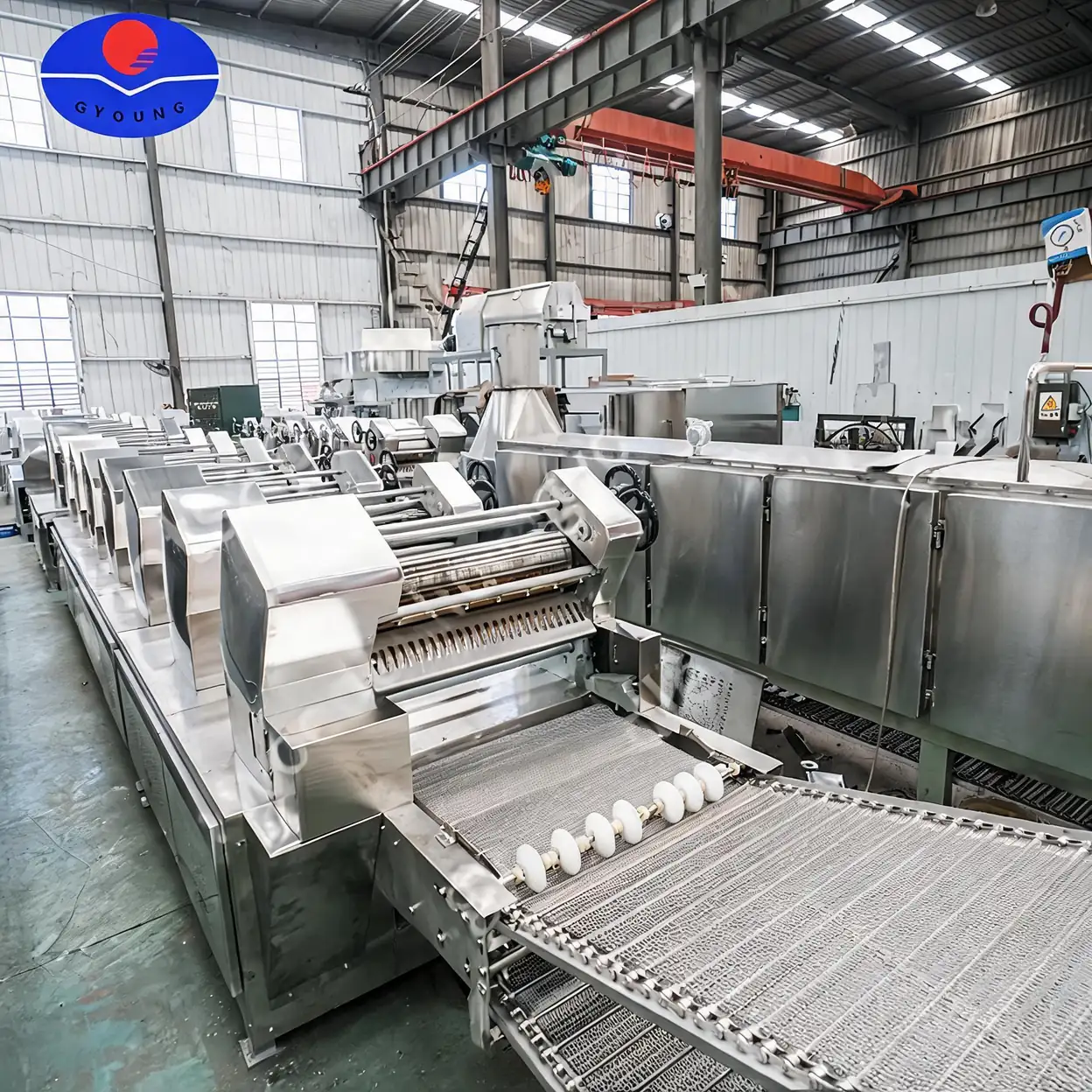
Equipment economics in Kenya are the same proven GYOUNG line-up used across emerging markets. An entry-level fried instant noodle line starts at $92,000–$96,000 FOB (excluding packaging machine), producing 30,000 packs per 8-hour shift with 2–3 operators, on a recommended footprint of about 15m × 40m. Configurations scale to 300,000 packs per shift. Automatic pillow-pack packaging is quoted separately, typically around $23,000 per unit depending on line speed.
A realistic project timeline:
- Manufacturing: about 3 months (90 days)
- Sea freight: roughly 30–45 days to Mombasa
- Installation & commissioning: at least 1 month on site, including operator training
- Total from order to first production: approximately 7 months
On the operating side, four cost lines dominate the per-pack number:
- Wheat flour — the single largest input, and the largest currency exposure (see section 5)
- Frying oil — for fried lines, volatile and directly exposed to global vegetable-oil prices
- Seasoning and packaging film — often underestimated; film cost per pack matters at low price points
- Energy and labor — Kenyan industrial electricity is not cheap by regional standards, so line efficiency and heat recovery have real financial value
Because Kenya's grid supply is generally more reliable than in several other African markets, the specification priority shifts: instead of generator hardening, the higher-return investment is usually energy efficiency and uptime — a line that runs a full shift without unplanned stops beats a cheaper line that idles.
5. Wheat Dependence, Local Substitution & Compliance
Kenya's wheat position is the defining risk in the business model. Domestic production typically covers less than 20% of national demand, with imports on the order of 2.4 million tonnes a year and Russia supplying the majority in recent seasons. That means your flour cost is effectively a global price plus freight plus duty, denominated in a currency you do not control.
Kenya applies a reduced 10% ad valorem duty on wheat imported from outside the EAC for registered millers participating in the Wheat Purchase Program, while non-participants face the EAC Common External Tariff of 35%. The exact treatment you face depends on your milling and procurement route — verify it before committing to a cost model.
Three practical responses:
- Blend, don't replace. Maize is widely available in Kenya, and cassava is grown in coastal and western counties, though supply is fragmented. Partial substitution — typically 10–30% — can shave input cost and reduce currency exposure without breaking the gluten network. GYOUNG's modular lines handle wheat, cassava, and sorghum with adjustable calendering and pre-gelatinization settings, but the formula must be validated against your actual flour samples.
- Lock supply, not just price. A flour supply agreement with a reputable miller is worth more than a spot-price win. Consistency of flour spec matters more to noodle quality than the last few dollars per tonne.
- Choose fried or non-fried deliberately. Fried lines give the classic texture and 12-month shelf life that travel well on long corridors. Non-fried (hot-air dried) lines cut oil content by 30–50% and reduce exposure to frying-oil prices — a credible mid-tier play for urban, health-aware buyers, but a harder sell at the lowest price points.
On compliance: products sold in Kenya must meet KEBS mandatory standards and labeling requirements, and food businesses need the relevant public-health and county licensing. Equipment should be built from 304 food-grade stainless steel with cleanable surfaces; GYOUNG lines carry CE and ISO 9001 certification. Build label artwork, nutrition declaration, and language requirements into your launch plan early — reprinting packaging is an expensive way to learn local rules.
6. Is Kenya the Right Fit for Your Project?
Kenya suits a specific investor profile — and it is not the same profile as Nigeria or Egypt.
It fits you well if you:
- Want a single production base serving multiple East African markets, not just one country
- Are willing to build the category rather than buy share in a saturated one
- Can operate a cost-disciplined, distributor-led route to market
- Will treat flour sourcing and currency as core business variables, not purchasing details
- Value port access and corridor logistics as a durable structural advantage
It requires more caution if you:
- Expect instant noodle volumes to behave like Nigeria or Egypt — Kenya is earlier-stage and smaller today
- Plan to import finished noodles rather than manufacture locally — duty and freight erode the price advantage that local production creates
- Assume regional sales are automatic — EAC preferences still require correct origin documentation and a real distributor network
- Have no plan for wheat price and KES volatility
Net net: Kenya is a corridor play with a growing domestic base attached. It rewards an operator who thinks in cartons, distributors, and borders — and who builds a line flexible enough to serve all three.
Frequently Asked Questions
Is Kenya a good market for instant noodle manufacturing?
Kenya suits a regional manufacturer rather than a pure domestic volume play. Consumption is still early-stage at roughly 167 million servings in 2025 (about three per person per year) but grew strongly between 2018 and 2022. The bigger advantage is structural: Mombasa port and the Northern Corridor give a Kenyan plant access to Uganda, Rwanda, Burundi, South Sudan and eastern DR Congo.
How much does an instant noodle production line cost in Kenya?
An entry-level fried or non-fried line starts around $92,000–$96,000 FOB excluding the packaging machine, producing 30,000 packs per 8-hour shift with 2–3 operators on a footprint of roughly 15m × 40m. Configurations scale to 300,000 packs per shift. Add packaging equipment (typically around $23,000 per unit), sea freight to Mombasa, installation, raw-material setup and working capital for the full budget.
How long does it take to set up a noodle factory in Kenya?
Plan roughly 7 months from order to first production: about 90 days for manufacturing, 30–45 days of sea freight to Mombasa, and at least one month for on-site installation, commissioning and operator training. Because Mombasa is a seaport, there is no long inland leg for imported equipment — a timing advantage over landlocked markets such as Zambia or Uganda.
Can a Kenyan noodle line use local maize or cassava flour?
Yes, with formulation work. Partial substitution of imported wheat flour with maize or cassava flour — typically 10–30% — can lower input cost and reduce currency exposure. Because cassava and maize flours lack wheat gluten, the line needs adjustable calendering and a pre-gelatinization section, and the recipe usually requires vital wheat gluten and a stabilizer to hold texture. Always validate against your actual local flour samples before scaling.
Can a Kenyan factory sell noodles to Uganda, Rwanda and DR Congo?
Yes — this is one of Kenya's main advantages. Kenya is an EAC member, and goods of Kenyan origin can qualify for preferential access to partner states subject to rules-of-origin compliance and correct documentation. Finished goods also move efficiently via the Northern Corridor from Mombasa through Nairobi to Kampala, Kigali, Bujumbura and eastern DRC. Confirm current tariff and origin requirements with a customs broker before finalizing pricing.
Planning a noodle production line for Kenya or East Africa?
Send us your target capacity, pack size and intended markets. GYOUNG CHINA will come back with a line configuration, factory layout plan and an indicative budget — including regional distribution considerations.
📩 Contact UsReferences / Data Sources:
- USDA Foreign Agricultural Service — Kenya: Grain and Feed Annual (KE2025-0006, March 2025) — wheat consumption forecast of 2.73 million MT in MY 2025/26 (+2.6%), import volumes, Wheat Purchase Program and duty treatment. apps.fas.usda.gov
- Milling Middle East & Africa (January 2026) — Kenyan domestic wheat output typically covers less than 20% of national demand; import supplier concentration. millingmea.com
- Kenya Ports Authority data reported by The Star (June 2025) and Daily Monitor (January 2025) — 2024 Mombasa throughput of ~41.1 million tonnes, 13.4 million tonnes transit cargo (+17.4%), and transit shares by destination (Uganda 65.7%, South Sudan 12.7%, DR Congo 11.8%, Rwanda 5.1%).
- World Instant Noodles Association (WINA) — global and country demand data; Kenya estimate of ~167 million servings in 2025 and ~160% growth 2018–2022 as cited in industry market research. instantnoodles.org
- Northern Corridor Transit and Transport Coordination Authority — Mombasa as gateway for Kenya, Uganda, Rwanda, Burundi, DR Congo, South Sudan, Tanzania, Somalia and Ethiopia; 1,700 km Northern Corridor. ttcanc.org
- GYOUNG product & logistics documentation (2026) — line configurations ($92,000–$96,000 FOB entry, 30,000 packs/8h; up to 300,000 packs/8h), 2–3 operators, 15m × 40m recommended plant, packaging at ~$23,000/unit, and lead times (manufacturing ~90 days, sea freight 30–45 days, installation ≥1 month).
- KEBS (Kenya Bureau of Standards) — mandatory standards and labeling requirements for food products sold in Kenya.
Related reading:
📌 Data Disclaimer: Market figures in this article — wheat consumption and imports, port transit volumes, instant noodle servings, and growth rates — are drawn from the public sources listed above and should be treated as directional estimates, not guarantees. Equipment prices, lead times and raw-material costs reflect GYOUNG's standard product documentation and typical market conditions and may change. Tariff treatment, rules of origin, food-safety, labeling and licensing requirements should be confirmed with a qualified local customs broker and compliance advisor. Any investment or payback picture is indicative — actual results depend on line scale, operational efficiency, procurement, logistics and local execution. This article is for informational purposes only and does not constitute investment or legal advice.