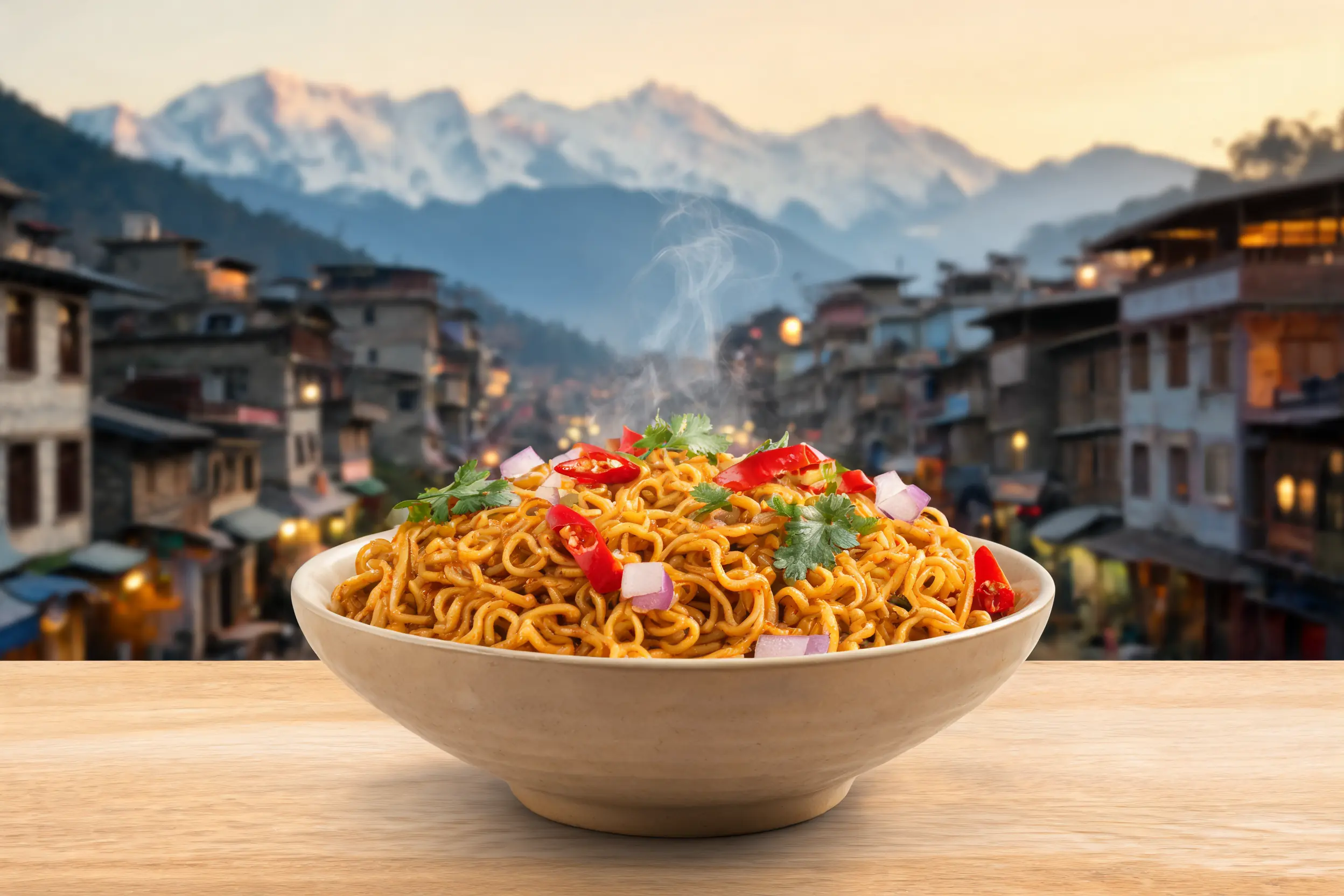
1. Nepal's Noodle Market: Small Country, Strong Consumption
Nepal is easy to overlook on a map — a landlocked Himalayan nation of roughly 31.9 million people. But in the world of instant noodles, it punches far above its weight.
Nepal ranks third globally in per-capita instant noodle consumption, at around 53 servings per person per year (WINA data). In plain terms: noodles are woven into daily life here, not an occasional convenience food.
This demand is powered by demography. 56% of the population — about 18 million people — is under 30, with a median age of just 25.6 years. That is precisely the core audience for instant noodle production: students, young workers, and urban families looking for fast, affordable meals.
Instant noodles in Nepal aren't a "Western import." Locally known as chauchau, they are a national snack. Nepal's trekking and mountain economy adds another layer of demand — noodles are a lightweight, high-calorie staple for porters, trekkers, and rural households far from kitchens.
2. Market Size & Growth Momentum
The numbers tell a consistent story: Nepal's noodle market is growing fast, and policy is firmly on the side of local producers.
| Metric | Figure | Source |
|---|---|---|
| Population (2026) | ~31.9 million | Market research (2024–25) |
| Per-capita consumption | 53 servings/person/year (world #3) | WINA |
| Market growth (CAGR 2025–2029) | 12.25% | Market research |
| Estimated market size (retail) | $150–200M (2024–25) | Market research |
On the competitive side, the market is led by Wai Wai (CG Foods, the long-standing category leader), with fast-rising challengers like Current (Yashoda Foods, growing ~31% year-on-year) and RumPum / 2PM (Asian Thai Foods), alongside local names such as Rara, Preeti, and GaZzabko.
3. Price & Cost Structure: Where the Margin Lives
For anyone evaluating a noodle production investment, the cost side is where Nepal genuinely stands out. Two structural advantages — cheap electricity and low labor — keep the manufacturing economics attractive.
Standard packs (60–75g) retail at NPR 20–25 (roughly $0.15–0.19), while innovative or premium flavors (Korean-style, spicy variants) command NPR 46–55 ($0.35–0.42) — a clear premium tier with room to grow.
Based on the market cost structure, manufacturing cost runs about NPR 8–10 per pack, with a factory-gate price of roughly NPR 10–12 per pack.
- Electricity: Industrial power costs about $0.071/kWh — among the lowest in the region, thanks to abundant hydropower.
- Labor: The minimum monthly wage is NPR 19,550 (about $147/month), one of the lowest in South Asia.
For reference, the cost breakdown per pack (indicative) is roughly: flour 35–40% (the largest single item), palm oil 15–20%, seasoning 10–15%, labor only 5–8%, and electricity just 3–5%. Labor and energy — two of the most controllable costs in any factory — are unusually favorable here.
4. Investment Return: Payback Outlook
Every investor asks the same question first: how fast does my money come back?
Rather than quote an equipment price tag (which varies by configuration, capacity, and automation level), it's more useful to think in terms of return profile driven by operating economics. In Nepal, the combination of low labor and electricity costs — plus a clear retail-to-cost spread — means the margins to recover an initial investment are structurally strong.
An important caveat: "payback" should be measured on a full-cycle basis. From order to first profitable output, a realistic timeline includes manufacturing and shipping lead time plus installation and commissioning — so plan on a somewhat longer horizon from signing to positive cash flow. The equipment itself may pay back quickly once running; the full project cycle takes longer.
5. Opportunities & Realistic Risks
Nepal's local spice tradition is a genuine differentiator. Local ingredients like Akabare chili pepper and Timur (Sichuan pepper) give producers a way to build flavor profiles that global competitors can't easily copy — and they align perfectly with the Nepali palate's preference for bold, spicy, local flavors.
No market is one-sided, and Nepal's biggest structural vulnerability lies in raw-material imports:
- Wheat: largely imported from India. India's 2022 wheat export ban caused Nepal's flour price to jump from NPR 50/kg to NPR 85/kg — a stark reminder of supply-chain fragility.
- Palm oil: entirely imported (Indonesia/Malaysia), with import prices swinging widely (2024 range roughly $780–1,329/ton).
- Logistics: as a landlocked, mountainous country, both inbound raw materials and outbound distribution carry higher transport costs.
These aren't reasons to avoid Nepal — they're reasons to plan procurement carefully, which is exactly what disciplined operators do in every emerging market.
6. Is Nepal Right for Your Noodle Project?
Nepal is a compelling fit for a specific profile of investor — but not a universal "yes" for everyone.
Nepal suits you well if you:
- Value low manufacturing costs (labor + electricity) as a core competitive lever
- Want to tap strong, culturally embedded local demand rather than build demand from scratch
- See opportunity in local-flavor differentiation (Akabare, Timur, regional spice profiles)
- Prefer a start-small, validate, then scale approach
It requires more caution if you:
- Depend on predictable, low-cost imported raw materials (wheat and palm oil volatility is real)
- Need large-scale export logistics immediately (landlocked distribution is costly)
The picture is balanced: strong demand, low operating costs, and clear margin opportunity on one side; import dependency and logistics friction on the other. For the right investor, the first side weighs heavier.
Frequently Asked Questions
Is Nepal a good market for instant noodle production?
Nepal is an attractive market for the right profile of investor. It ranks world #3 in per-capita noodle consumption (~53 servings/person/year), the market is growing at 12.25% CAGR, and both electricity (~$0.071/kWh) and labor (~$147/month minimum wage) are among the lowest in the region. The main structural risks are import dependency on wheat and palm oil, plus landlocked logistics.
How fast can an instant noodle line pay back in Nepal?
Based on typical market benchmarks, an operator can expect an estimated payback period of several months, depending on line scale and operational efficiency — a return profile driven by low labor and electricity costs. On a full-cycle basis (manufacturing + shipping + installation + commissioning), plan on a longer horizon from order to positive cash flow.
What are the main costs of making instant noodles in Nepal?
Flour is the largest single cost at roughly 35–40% of the per-pack cost, followed by palm oil (15–20%), seasoning (10–15%), packaging (8–12%), and labor (5–8%). Electricity is only 3–5%. Manufacturing cost runs about NPR 8–10 per pack, against a factory-gate price of NPR 10–12 per pack.
What raw materials does Nepal import for noodle production?
Wheat is largely imported from India (exposed to Indian export policy — the 2022 ban pushed flour from NPR 50/kg to 85/kg), and palm oil is entirely imported from Indonesia and Malaysia. On the other hand, Nepal has a genuine advantage in local spices like Akabare chili and Timur pepper, which support differentiated, locally authentic flavors.
What is the typical retail price of instant noodles in Nepal?
Standard 60–75g packs retail at NPR 20–25 (about $0.15–0.19), while Korean-style or spicy premium variants command NPR 46–55 ($0.35–0.42). This gives a clear premium tier with room for margin growth through differentiated flavors.
Planning a noodle production line in Nepal?
Contact GYOUNG CHINA for a tailored breakdown of line configurations, factory layout guidance, and an investment outlook matched to your target capacity.
📩 Contact UsReferences / Data Sources:
- World Instant Noodles Association (WINA) — Global and country-level instant noodle consumption data, including Nepal's per-capita rank (world #3, ~53 servings/person/year).
- GYOUNG internal market research — Nepal Instant Noodle Market Report (Aug 2026) — population & demographics (~31.9M, 56% under 30, median age 25.6), market CAGR (12.25%, 2025–2029), estimated retail market size ($150–200M, 2024–25), competitive landscape (Wai Wai/CG Foods, Current/Yashoda, RumPum/2PM/Asian Thai, Rara, Preeti, GaZzabko), retail price anchors (NPR 20–25; premium NPR 46–55), manufacturing cost (NPR 8–10/pack) and factory-gate price (NPR 10–12/pack), and cost structure (flour 35–40%, palm oil 15–20%, seasoning 10–15%, labor 5–8%, electricity 3–5%).
- GYOUNG ROI model (Aug 2026) — per-pack margin and cost benchmarks for Nepal, used as the basis for the indicative payback outlook.
- ICRA Nepal — CG Foods (Wai Wai) credit rating and financial metrics (FY2024, 9MFY2025), cited within the market research report.
- Tridge / Kathmandu Post / New Business Age / GlobalPetrolPrices / NEA / IndexBox / ResearchGate — trade, raw-material price (wheat NPR 50→85/kg after the 2022 India export ban; palm oil $780–1,329/ton), electricity tariff ($0.071/kWh industrial), and labor wage (minimum NPR 19,550/month) data points compiled in the market research report.
📌 Data Disclaimer: Market figures in this article — market size ($150–200M), growth rate (12.25% CAGR), retail prices (NPR 20–25), manufacturing costs (NPR 8–10/pack), and cost structure percentages — are drawn from third-party market research based primarily on 2024–2025 data and should be treated as directional estimates, not guarantees. Exchange rates (NPR to USD), raw-material prices (wheat, palm oil), and wage levels fluctuate and may have changed since publication. The payback outlook is an indicative benchmark based on typical market conditions — actual results depend heavily on line scale, operational efficiency, procurement strategy, and local market execution. This article is for informational purposes only and does not constitute investment advice.