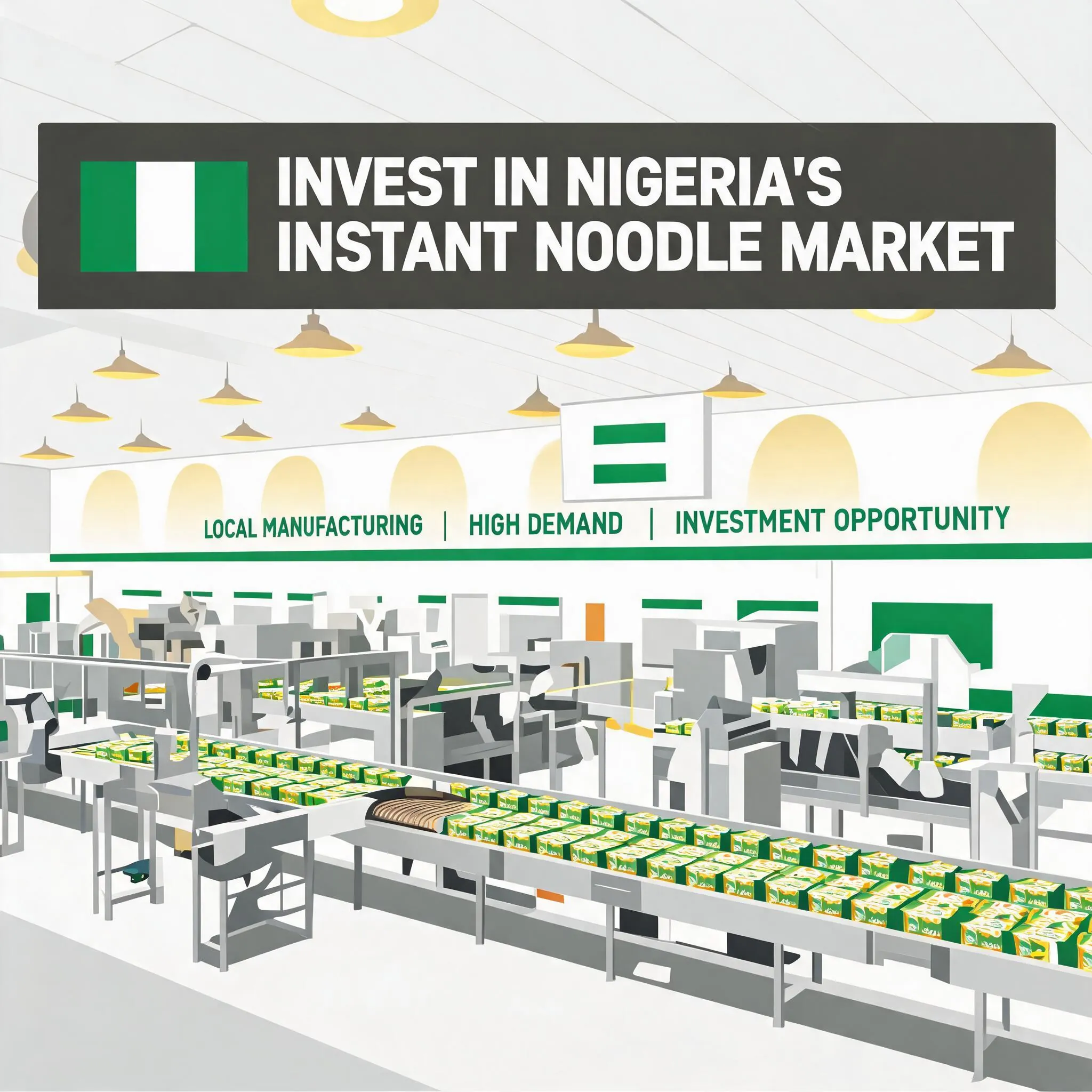
1. Africa's Most Underrated FMCG Powerhouse
Nigeria — Africa's most populous nation with 220 million people and a median age of just 18. This extraordinarily young country is becoming a battleground for global FMCG giants, and the most underestimated category of all is instant noodles.
According to industry data, Nigeria consumes billions of packs of instant noodles annually, with a market size reaching hundreds of millions of dollars. Indomie (owned by Dufil Prima Foods) dominates with a 60%+ market share, but the remaining ~40% is being steadily chipped away by local players.
For SME investors, this market is far from saturated.
2. Why Now Is the Golden Window
① Structural gaps in the market
Indomie may lead overall, but significant supply gaps remain in premium flavors, budget-friendly packs, and children's nutritional noodles. Local brands can absolutely break through with differentiated flavors and packaging.
② Consumption upgrade is underway
Nigeria's middle class is expanding. Consumers are shifting from unbranded bulk noodles to branded, portion-controlled, multi-flavor products — and they're willing to pay a premium for quality.
③ Policy barriers create a moat
The Nigerian government actively encourages local manufacturing. Imported finished instant noodles face 30–40% tariffs, giving local production a substantial cost advantage.
④ Local raw-material substitution is maturing
Traditional noodles rely on imported wheat flour, but cassava/sorghum blending technology is maturing fast. This reduces import dependence and qualifies for local-procurement tax incentives.
3. How Attractive Is the ROI?
Based on a medium-scale instant noodle production line (75,000 packs/day, 1.8 million packs/month):
| Item | Estimate |
|---|---|
| Retail price per pack | NGN 160–200 ($0.11–0.13) |
| Production cost per pack | NGN 100–130 |
| Gross profit per pack | NGN 50–70 (30–40% margin) |
| Monthly revenue | NGN 288–360M ($192K–240K) |
| Monthly net profit | NGN 54–72M ($36K–48K) |
Now to the crucial number — investment payback period:
| Line Scale | Total Investment | Est. Annual Net Profit | Payback Period |
|---|---|---|---|
| Small (20–50K packs/day) | Contact for a tailored quote | $200K–400K | ~4–6 months |
| Medium (50–100K/day) | Contact for a tailored quote | $350K–580K | ~4–6 months |
| Large (100K+/day) | Contact for a tailored quote | $600K–1.2M | ~6–10 months |
A medium-scale line (competitive pricing — contact us for details) generates $350K–580K in annual net profit — payback in under six months.
4. Cash Flow: Why This Business Suits SME Investors
Instant noodles is one of the healthiest cash-flow categories in FMCG:
- Fast turnover: Production-to-cash collection cycle is typically 30–45 days
- Moderate entry barrier: Medium line with competitive pricing, ~1,000m² space, only 2–3 operators
- Recession-proof: Economic downturns actually boost demand as consumers switch to affordable alternatives
- Export potential: Nigeria can serve as a hub for the entire ECOWAS region — 300 million consumers
5. What the Success Stories Tell Us
Master Noodles (Tummy-Tummy Group) is the benchmark. It entered the mid-to-low end with affordable pricing and localized flavors, partnering deeply with regional distributors to build a solid network across south-central Nigeria. Its growth proves: a local brand can carve its own path under Indomie's shadow.
Doyin Noodles took the mid-market route — importing noodle production lines from China and matching Indomie on quality while building a brand of its own. It's now a go-to alternative for Indomie-weary consumers.
6. Risk Checklist — and How to Mitigate
| Risk | Mitigation |
|---|---|
| FX risk — persistent Naira depreciation | Gradually increase local raw material (cassava/sorghum) ratio; adjust pricing dynamically; consider partial foreign-currency invoicing |
| Power instability | Invest in efficient diesel generators + solar backup; choose energy-saving equipment |
| Brand competition | Differentiate via flavor, packaging, and children's nutrition lines; start with 1–2 states before expanding |
Final Word
Nigeria's instant noodles market is transitioning from a "one-superpower" structure to meaningful multi-brand competition. For investors with moderate capital and a willingness to go deep into Africa, this is a rare window — moderate entry cost, fast payback, healthy cash flow, and a market that is still far from saturated.
The titans have already voted with their money. What's stopping you?
Frequently Asked Questions
How much does it cost to set up an instant noodle factory in Nigeria?
A small-scale noodle factory (20,000–50,000 packs/day) requires competitive investment in noodle production line equipment, plus working capital for facility preparation and initial raw materials. A medium-scale line (50,000–100,000 packs/day) — contact us for a tailored quote. ROI is achievable in 4–6 months.
How long does it take to install and commission a noodle production line?
Total lead time from order confirmation to full production is approximately 7 months. This includes ~90 days of manufacturing in China, ~45 days of sea freight to Lagos, 30 days for on-site installation and commissioning by Chinese engineers, plus operator training. GYOUNG provides turnkey delivery from factory layout design through to first production.
Do you provide after-sales service and training for African clients?
Yes. GYOUNG sends experienced Chinese engineers to your factory for full installation, commissioning, and hands-on operator training. We provide a 1-year comprehensive warranty, lifetime technical support via WhatsApp/WeChat with 24-hour response, and ship common spare parts together with the equipment. We have successfully installed 10+ production lines across Nigeria, Zambia, and other African markets.
What is the average ROI period for an instant noodle factory in Nigeria?
Based on our existing African clients' performance, a small to medium-scale instant noodle factory in Nigeria typically achieves full investment payback within 4–6 months. Gross profit margins range from 30–40% per pack, the production-to-cash cycle is 30–45 days, and Nigeria's 220 million population provides strong, recession-resistant demand driven by the product's affordability.
Can your noodle lines use local raw materials like cassava flour?
Absolutely. GYOUNG noodle production lines are engineered to handle blended flour formulas including cassava, sorghum, and other locally available African starches in addition to traditional wheat flour. This supports local raw material substitution, reduces import costs and FX exposure, and may also qualify investors for local procurement tax incentives under Nigerian government policy.
Ready to start your noodle factory in Nigeria?
Contact GYOUNG CHINA for detailed quotations, factory layout plans, and customized investment solutions. We've delivered 10+ production lines across Africa.
📩 Contact UsReferences:
- Business Post Nigeria — Extensive Distribution Network, Promotional Activities Buoy Indomie 60% Noodles Market Share (June 10, 2026). GCR Ratings report: Indomie (Dufil Prima Foods) 60%+ market share; Dufil FY2025 revenue NGN 1.1 trillion; capacity expansion planned for 2026.
🔗 https://businesspost.ng/economy/extensive-distribution-network-promotional-activities-buoy-indomie-60-noodles-market-share/ - World Instant Noodles Association (WINA) — Global instant noodle consumption reached 120.21 billion servings in 2023. Nigeria is Africa's largest instant noodle market, ranking among the global top 10.
- US International Trade Administration (trade.gov) — Nigeria – Import Tariffs. Nigeria applies ECOWAS Common External Tariff (CET). Strategic raw materials: wheat 85%, sugar 75%, rice 70% to encourage local manufacturing.
🔗 https://www.trade.gov/country-commercial-guides/nigeria-import-tariffs - The Business Research Company — Instant Noodles Market Report 2026. Global market grew from $61.52B (2025) to $66.81B (2026), CAGR 6.9%.
🔗 https://www.researchandmarkets.com/reports/5819909/instant-noodles-market-report - DutyCalc Nigeria — Nigeria import duty calculator. VAT 7.5%, FCS 4%, surcharge 7%. High import tax burden further favors local production.
🔗 https://www.dutycalc.ng/duty-calculator - StatLedger Market Research — Nigeria Instant Noodles Market – Trend Analysis & Forecasts (May 2024).
🔗 https://www.marketresearch.com/...