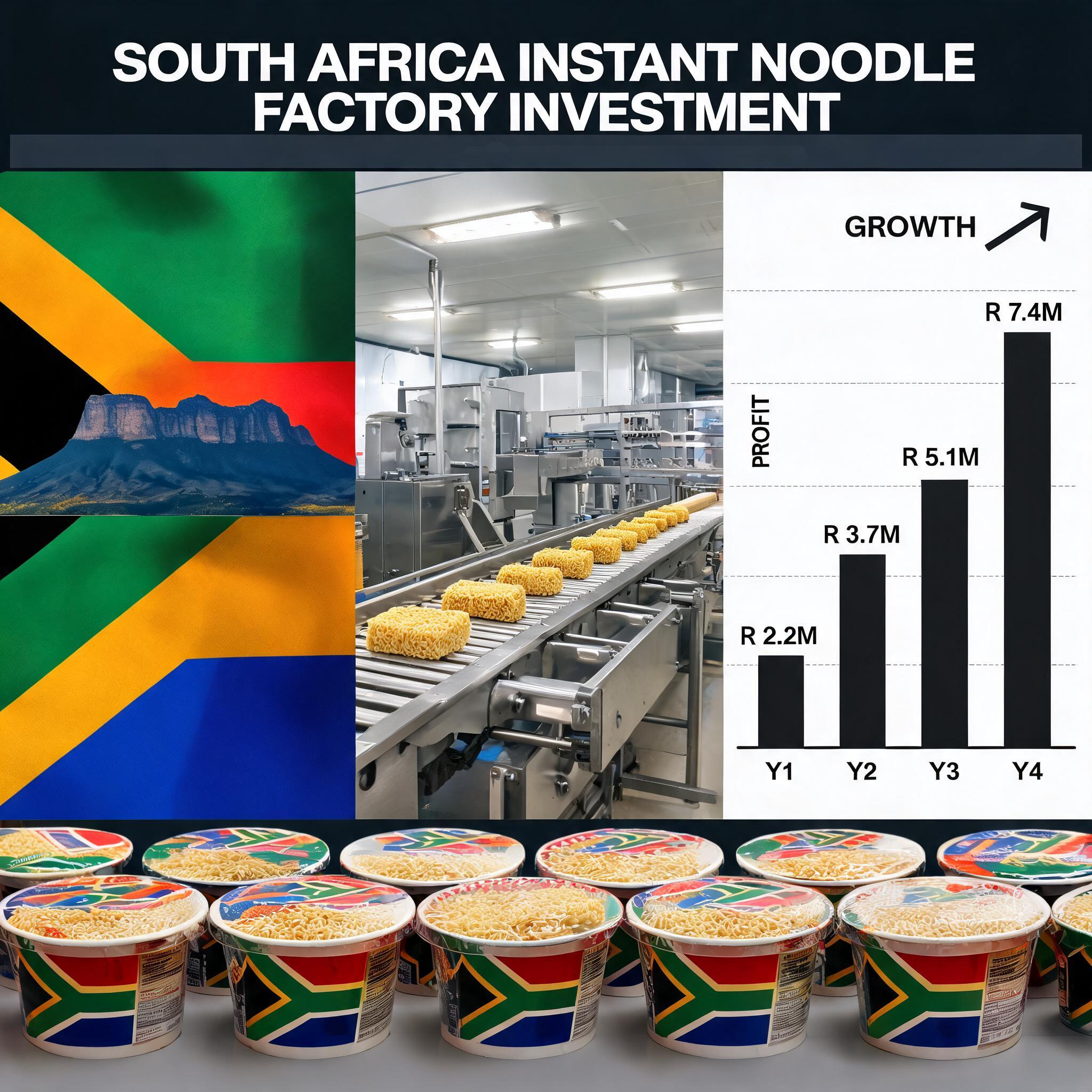
1. South Africa: Why Africa's Most Industrialized Economy Is Ready for Noodle Manufacturing
South Africa is Africa's most industrialized economy — and it shows in the numbers. With 63 million consumers, a $85M+ instant noodle market, and a steady 5-7% annual growth rate, this is a market that rewards serious food manufacturing investment.
The numbers tell a compelling story. Retail prices range from $0.37 to $0.49 per pack — a level that reflects genuine consumer purchasing power and allows healthy profit margins at every stage of the value chain. A single production line running 100,000 packs per day can generate roughly $200,000 in net profit per month.
Maggi (Nestlé), Kellogg's, Indomie, and a growing roster of private-label brands are already competing for shelf space at Checkers, Pick n Pay, and Shoprite. These aren't fly-by-night operations — Nestlé and Kellanova have been investing in South Africa for decades, and their presence validates the market's long-term viability. This is a mature, profitable, brand-driven market — not a race-to-the-bottom commodity play.
What makes South Africa unique for food manufacturers goes beyond the noodle aisle. The country offers something most African markets simply can't match: mature commercial infrastructure (banking, insurance, logistics), a well-defined legal and regulatory framework for food safety, and world-class port facilities at Durban and Cape Town. As the anchor economy of the SACU trade bloc, a factory here gives you duty-free access to 72 million consumers across five countries. If you're serious about building a sustainable food manufacturing business in Africa, South Africa is where the foundations are already in place.
2. Market Snapshot: Who's Playing, Who's Winning
Market Size & Growth
| Metric | Value | Source |
|---|---|---|
| 2024 Market Size | $85.25M | DataBridge Market Research |
| 2032 Forecast | $117.23M | DataBridge (CAGR 5.21%) |
| Retail Channel Share | 83% store-based | DataBridge |
| Brand vs Private Label | 78% branded, 22% private label | DataBridge |
| Fried vs Non-Fried | 63% fried noodles | DataBridge |
The market grows at 5-7% CAGR, driven by urbanization, dual-income households, and the convenience-food shift. It's steady, sustainable growth — not a hype cycle — which means manufacturers can plan capacity expansion with confidence rather than chasing a moving target.
Competitive Landscape
South Africa's noodle aisle is surprisingly crowded for a market this size:
| Brand | Parent Company | Est. Share | Strategy |
|---|---|---|---|
| Maggi | Nestlé (Switzerland) | 35-40%* | Market leader, 68g five-pack dominates |
| Kellogg's | Kellanova (USA) | 15-20% | Eight-pack value strategy, strong brand recognition |
| Indomie | PT Indofood (Indonesia) | 10-15% | Mi Goreng differentiation, fried noodle specialist |
| Roka / Mr. Pasta | Local brands | 10-15% | Price-fighter positioning (R6-7/pack) |
| Private Label | Shoprite, Pick n Pay | 10-15% | Hyper Value brand, 60g eight-pack at R34.99 |
* Industry estimate. Exact Maggi share data is behind paywalled reports (Sagaci Research).
What It Costs on the Shelf
Actual retail prices from Checkers/Sixty60 (July–August 2026):
| Brand | Product | Pack Size | Retail Price | Per Pack |
|---|---|---|---|---|
| Maggi | Beef 2-Minute Noodles | 68g × 5 | R39.99 | R8.00 |
| Maggi | Chicken 2-Minute | 68g × 5 | R38.99 | R7.80 |
| Kellogg's | Beef Instant Noodles | 70g × 5 | R39.99 | R7.99 |
| Indomie | Mi Goreng Fried | 85g × 5 | R37.99 | R7.60 |
| Roka | Chicken Instant | 85g × 5 | R34.99 | R7.00 |
| Mr. Pasta | Beef Instant | 60g × 5 | R29.99 | R6.00 |
| Hyper Value | Beef (Private Label) | 60g × 8 | R34.99 | R4.37 |
The sweet spot is R7-8 per pack ($0.40-0.49). Private-label products at R4.37 are the exception — lighter 60g packs, no brand marketing costs. At these price levels, there's a genuine profit margin for manufacturers, with enough headroom to cover production costs, invest in distribution, and still deliver healthy returns.
3. The Margin Story: Why South African Noodle Manufacturing Works
Before we get to equipment and timelines, let's talk about the one number that matters most: net profit per pack. Here's how the unit economics stack up for a standard 70g instant noodle produced in South Africa:
| Metric | USD Value | Notes |
|---|---|---|
| Retail Price (per pack, 70g) | $0.37–0.49 | Based on Checkers/Sixty60 live pricing, Aug 2026 |
| Estimated Factory-Gate Price | $0.263 | Derived from retail minus ~35% channel markup |
| Total Production Cost | $0.186 | Full breakdown in Section 4 below |
| Gross Profit Per Pack | $0.077 | 29.3% gross margin |
| Daily Net Profit (100K packs) | $7,705 | 26 operating days/month |
| Monthly Net Profit | $200,327 | ~$2.3M annually from one line |
| Estimated Payback Period | 6–8 months | Based on mid-tier market positioning |
Is a 29.3% gross margin healthy? Let's put it in context. Nestlé — the parent company of Maggi, the dominant brand in the South African noodle aisle — reports a global operating profit margin of approximately 17%. That's Nestlé's margin after corporate overhead, brand marketing, R&D, and global logistics. A 29.3% gross margin at the factory level — before those corporate costs — is right where you want to be. It gives you genuine room to invest in distribution, build a brand, absorb currency fluctuations, and still turn a strong profit.
These numbers aren't magic — they're the result of a market where retail prices reflect real consumer purchasing power ($0.37–0.49/pack), where electricity costs ($0.11–0.14/kWh industrial) are competitive by emerging-market standards, and where a mature retail infrastructure means your product reaches shelves efficiently. The math works — and that's exactly why Nestlé, Kellanova, and Indofood have been in this market for years.
4. The Unit Economics: What One Pack Really Costs
Before you calculate profit, you need to understand cost. Here's the full breakdown for a 70g pack of instant noodles manufactured in South Africa, based on 2026 publicly available market data:
| Cost Item | Per Pack (ZAR) | Per Pack (USD) | % of Total |
|---|---|---|---|
| Wheat Flour (~50g) | R0.40 | $0.022 | 11.8% |
| Palm Oil (~12ml) | R0.25 | $0.014 | 7.4% |
| Seasoning & Additives (~10g) | R0.60 | $0.033 | 17.6% |
| Packaging Materials | R0.50 | $0.027 | 14.7% |
| Labor | R0.35 | $0.019 | 10.3% |
| Electricity & Energy | R0.30 | $0.016 | 8.8% |
| Depreciation & Maintenance | R0.50 | $0.027 | 14.7% |
| Other (Water, Logistics, Admin) | R0.50 | $0.027 | 14.7% |
| Total Production Cost | R3.40 | $0.186 | 100% |
At an estimated factory-gate price of R4.81 per pack (derived from market retail prices minus ~35% channel markup), each pack delivers:
- Gross profit: R1.41 per pack ($0.077)
- Gross margin: 29.3%
That's a healthy margin by any FMCG standard. For context: Nestlé's global operating margin is ~17%. A 29% gross margin at the factory level — before brand marketing and corporate overhead — gives you real room to compete, invest in distribution, and still turn a profit.
The biggest cost driver isn't what you'd expect. Seasoning and packaging together account for 32.3% of COGS, exceeding flour (11.8%). This is actually good news — both are areas where GYOUNG's integrated production approach and China-competitive supply chain can significantly reduce costs vs. local procurement.
5. The Full Profit Picture: 100,000 Packs/Day Line
Based on a medium-scale instant noodle production line producing 100,000 packs/day (70g each), operating 26 days/month, 300 days/year:
| Item | Daily | Monthly (26 Days) | Annual (300 Days) |
|---|---|---|---|
| Production Volume | 100,000 packs | 2,600,000 packs | 30,000,000 packs |
| Factory Revenue (@R4.81/pack) | R481,000 ($26,284) | R12,506,000 ($683,388) | R144,300,000 ($7,885,246) |
| Total Production Cost (@R3.40/pack) | R340,000 ($18,579) | R8,840,000 ($483,060) | R102,000,000 ($5,573,770) |
| Net Profit | R141,000 ($7,705) | R3,666,000 ($200,327) | R42,300,000 ($2,311,475) |
| Equipment Investment | Varies by line configuration — request a quote | ||
| Estimated Payback | ~6-8 months | ||
A net profit of $200,327 per month — that's $2.3 million annually from a single production line. The equipment pays for itself in roughly half a year, and every month after that prints profit.
These numbers assume a mid-tier market position — pricing around Roka/Indomie levels rather than premium Maggi. If you can build a brand that commands R7.80-8.00 per pack at retail (like Maggi), your factory-gate price increases and margins widen further.
6. The Eskom Problem — and the GYOUNG Energy Advantage
Let's address the elephant in the room: South Africa's electricity isn't just expensive — it's historically unreliable. But the situation has changed significantly, and there's a manufacturing advantage to be found.
The Good News: Load Shedding Has Stopped
After the brutal 2022-2024 period when South Africa experienced 6,947 hours of blackouts in a single year (Stage 6 was the norm), Eskom's recovery has been remarkable. Load shedding has been suspended since May 16, 2025 — over a year without scheduled blackouts. The Energy Availability Factor (EAF) recovered from 54.7% to 64-67%.
The Bad News: Electricity Is Still Expensive — and Rising
South African industrial electricity at R2.00-2.50/kWh is 3-4× what Chinese manufacturers pay. And NERSA has approved annual increases of 8-12% through 2027. For a noodle factory consuming substantial power for mixing, steaming, frying, and drying, this is the single largest structural cost risk.
| Comparison | South Africa | China | Impact on Noodle Factory |
|---|---|---|---|
| Industrial electricity | R2.00-2.50/kWh | ~R0.80/kWh | 3-4× higher per unit |
| Electricity cost per 100K packs | R30,000/day | ~R10,000/day | R520K/month difference |
| Annual increase (2025-2027) | 8-12% | 2-3% | Compounds over time |
The GYOUNG Response: Energy-Efficient Design
This is where equipment choice makes a measurable difference. GYOUNG's latest-generation continuous fryers use 15-20% less energy than industry-standard models through:
- Insulated oil tanks with heat-recovery jackets — recapture waste heat from exhaust
- Precision temperature control (±1°C) — no over-heating, no energy wasted
- Variable-frequency drives (VFD) on all major motors — only use the power you need
At South African electricity rates, a 15% reduction in energy consumption saves approximately R50,000 per month on a 100,000 pack/day line. Over a year, that's R600,000 — enough to pay for the energy-efficiency upgrade several times over.
7. SACU Advantage: One Factory, Five Markets
South Africa belongs to the Southern African Customs Union (SACU) — the world's oldest customs union. This means goods manufactured in South Africa can be exported duty-free to four additional countries:
| Country | Population | GDP per Capita | Noodle Market Status |
|---|---|---|---|
| South Africa | 63M | $6,700 | Mature, branded market |
| Botswana | 2.7M | $7,700 | Growing, imports from SA |
| Namibia | 2.6M | $5,000 | Small, SA-supplied |
| Lesotho | 2.3M | $1,200 | Price-sensitive, high noodle consumption |
| Eswatini | 1.2M | $3,900 | Small, SA-dependent |
| SACU Total | ~72M | — | Duty-free access |
Build one factory in South Africa, sell to 72 million consumers with zero tariffs. The SACU agreement means no customs paperwork at borders, no rules of origin complications, and no tariff calculations. Botswana and Namibia in particular have growing urban populations and under-served noodle markets — a South African factory can supply them within 48 hours by road.
Many emerging-market free trade zones look good on paper but struggle with implementation — inconsistent tariff enforcement, infrastructure gaps, and customs friction can turn a theoretical customs union into a paperwork nightmare. SACU is the exception. As the world's oldest functioning customs union, it has decades of institutional experience, harmonized standards, and real logistics infrastructure that makes cross-border trade genuinely frictionless for manufacturers based in South Africa.
8. Halal: Not Optional, It's the Entry Ticket
South Africa's Muslim population is small — approximately 2.8% of 63 million, or about 1.77 million people. But that number understates the commercial importance of Halal certification by an order of magnitude.
South Africa's Halal food market is estimated at $2.5-3 billion, driven by three factors:
- Muslim purchasing power: South Africa's Muslim community is concentrated in Cape Town and Durban — both major commercial hubs with above-average household incomes
- Mainstream supermarket requirements: Shoprite, Pick n Pay, and Woolworths all maintain dedicated Halal sections. If you want shelf space in the category leader's stores, Halal certification is increasingly a de facto requirement
- Export gateway: South Africa is a recognized Halal export hub for sub-Saharan Africa and the Middle East. A Halal-certified factory in Johannesburg or Durban opens doors to markets with significantly larger Muslim populations
Maggi 2-Minute Noodles already carry Halal certification. Kellogg's Instant Noodles carry Halal certification. The local brand Alhami is built entirely around a Halal-first positioning. If you're entering this market without Halal compliance, you're excluding yourself from every major retail channel. Work with a local certifying body (SANHA, MJC, or ICSA) for the facility audit before starting production.
9. From Zero to Production in ~7 Months
GYOUNG provides full turnkey delivery — from your first inquiry to the first pack coming off the line. Here's the timeline for a South Africa deployment (destination: Durban port):
| Phase | Duration | What Happens |
|---|---|---|
| ① Factory Design & Planning | 25 days | GYOUNG engineers design your factory layout, utility requirements, and workflow — optimized for your specific site |
| ② Equipment Manufacturing | ~90 days | Your production line is built to order at GYOUNG's factory in China — all components tested before shipping |
| ③ Sea Freight to Durban | ~45 days | Full container load, insured, with all documentation for SARS customs clearance |
| ④ Installation & Commissioning | ~30 days | Chinese engineers fly to your site for assembly, calibration, test runs, and operator training |
| Total: Order to Production | ~7 months | Plus 2-3 months for facility construction if you don't have a factory yet |
We've delivered 10+ production lines across Africa — Nigeria, Zambia, and other markets. Our engineers know African conditions: dust, humidity, voltage fluctuations, and the importance of training operators who may have never run automated food equipment before.
10. Risk Checklist — and How GYOUNG Mitigates Each
| Risk | Severity | GYOUNG Mitigation |
|---|---|---|
| Electricity price escalation — NERSA approved 8-12% annual increases through 2027 | 🔴 High | Low-energy fryer design saves 15-20% vs industry standard. We strongly recommend pairing with solar — a 200kW system offsets ~45% of daytime consumption and pays back in 4-5 years |
| Palm oil import dependency — 100% imported, 25-40% annual price volatility | 🟡 Medium | GYOUNG lines handle multiple oil types. Our flexible formulation support helps you adjust oil blends based on market prices — sunflower, soybean, or blended oils can partially substitute palm oil without quality loss |
| Brand competition — Maggi 35-40%, Kellogg's 15-20%, Indomie 10-15% | 🟡 Medium | Differentiate via peri-peri/Durban curry/localized flavors + Halal certification + private-label opportunities. The 22% private-label share is growing — retailers actively seek manufacturing partners |
| VAT increases — from 15% to 15.5% (2025) to 16% (April 2026) | 🟢 Low | VAT applies equally to all manufacturers — it's a level playing field. Build the 16% rate into your cost model from day one |
| Port congestion at Durban — can add 2-3 weeks to delivery | 🟡 Medium | We pad the timeline with 2-week buffer. Our freight forwarders have 15+ years of Durban port experience and priority berthing arrangements |
Final Word
South Africa's instant noodle market may not be the largest in Africa by volume — but for investors who care about profit per pack and sustainable unit economics, it's in a league of its own. $0.37–0.49 retail prices, genuine gross margins above 29%, and the SACU trade bloc giving you duty-free access to 72 million consumers across five countries. The math works — and that's why Nestlé, Kellanova, and Indofood have been building their positions here for years.
The challenges are real — electricity costs are 3-4× China's and rising 8-12% annually, palm oil is 100% imported, and you're competing against Maggi and Kellogg's on their home turf. But with GYOUNG's energy-efficient equipment design, Halal-ready production lines, and 10+ Africa deployments of experience, these are solvable problems.
A medium-scale line can generate $200,000 per month in net profit — and pay for itself in 6-8 months. After that, it prints money.
Ready to start your noodle factory in South Africa?
Contact GYOUNG CHINA for detailed quotations, factory layout plans, and customized investment solutions. We've delivered 10+ production lines across Africa — now let's talk about South Africa.
📩 Contact UsReferences:
- DataBridge Market Research — South Africa Instant Noodles Market Report 2025-2032. Market size $85.25M (2024), CAGR 5.21%, segmented by channel/price tier/brand type/noodle type/packaging/flavor.
🔗 https://www.databridgemarketresearch.com/reports/south-africa-instant-noodles-market - Checkers / Sixty60 — Retail price data collected July-August 2026. Maggi, Kellogg's, Indomie, Roka, Mr. Pasta, and Hyper Value pricing from Checkers online store and Sixty60 delivery platform.
- StrategyHelix — South Africa Instant Noodles Market 2026-2031. Competitive dynamics, brand positioning, and private-label growth trends.
- IndexBox — Africa Instant Noodles Market Report 2026. Regional production costs, palm oil import data, and continental market trends.
- StatsSA — Quarterly Employment Statistics Q1 2026. Manufacturing average monthly earnings R25,190; national average R29,997.
🔗 https://www.statssa.gov.za - NERSA (National Energy Regulator of South Africa) — Eskom tariff approvals for 2025/26, 2026/27, and 2027/28. Industrial tariffs and multi-year price determination.
🔗 https://www.nersa.org.za - HalalExpo South Africa — South Africa Halal Market Overview 2026. Market size $2.5-3B, Muslim population demographics, certification landscape.
🔗 https://www.halalexpo.co.za - TradingEconomics — Palm oil futures pricing (August 2026: MYR 4,677/ton) and South Africa manufacturing wage indices.
🔗 https://tradingeconomics.com - SACU Agreement (2002) — Intra-SACU trade provisions: duty-free movement of goods manufactured within the customs union (South Africa, Botswana, Namibia, Lesotho, Eswatini).
🔗 https://www.sacu.int