1. The Rise of Multi-Grain Instant Noodles
The global instant noodle market is undergoing a fundamental shift — from pure wheat flour toward multi-grain and fortified formulations. Two converging forces drive this transformation: rising consumer health awareness, and the economic pressure on emerging-market manufacturers to substitute imported wheat with locally available grains.
According to Mordor Intelligence (June 2026), the global instant noodles market is projected to grow from $51.03 billion in 2025 to $87.21 billion by 2031 — a CAGR of 9.39%. Fortified noodles enriched with vitamins and minerals contribute an additional +1.5% to that growth rate, with Sub-Saharan Africa and Asia-Pacific among the primary beneficiaries. Meanwhile, the broader pasta and noodles market sees ancient-grain categories like millet charting an independent CAGR of 7.21% (Mordor Intelligence, global pasta & noodles report).
Dataintelo (April 2026) reports that multi-grain noodles already account for 13.5% of the high-protein noodles market, with an 8.1% CAGR projected through 2034. These products attract consumers seeking both "diverse nutrition" and "complex flavor profiles" — a combination pure wheat noodles cannot deliver.
Why Emerging Markets Need Multi-Grain Formulations
For manufacturers in Africa, Southeast Asia, and Latin America, the case for multi-grain goes far beyond marketing:
- Foreign exchange exposure: Many countries spend billions on wheat imports — Nigeria alone spent an estimated $2 billion annually before recent currency volatility made this increasingly unsustainable. Substituting 17% of wheat with local grains directly reduces USD exposure.
- Local grain cost advantage: Sweet potato flour ($250–400/ton), corn flour ($200–350/ton), and soy flour ($400–550/ton) cost substantially less than imported wheat flour ($600–900/ton), even before adding tariffs and logistics costs.
- Government incentives: Several African and Southeast Asian governments offer tax breaks, import duty reductions, or direct subsidies for food manufacturers who incorporate locally sourced agricultural products.
- Clean label trend: Food Ingredients First (May 2025) reports that 30% of new food products globally now carry "no additives" or "natural ingredients" claims — making multi-grain's diverse ingredient list an automatic marketing asset.
2. Understanding the Gluten Threshold
The chewy, springy texture of instant noodles depends entirely on the gluten network — a three-dimensional protein matrix formed when glutenin (providing elasticity) and gliadin (providing extensibility) hydrate and align during mixing and sheeting. Research by Gulia & Khatkar (2015) quantified this relationship: glutenins show an R² of 0.619 with instant noodle texture, while gliadins show R² = −0.567 — confirming that the protein composition of your flour directly determines noodle quality.
Industry consensus sets a clear performance threshold: wet gluten content must be ≥28% for trouble-free calendering, intact noodle strands after steaming, and the characteristic crispy texture after frying. Fall below this line, and you encounter sheet tearing, soft/mushy mouthfeel, and high cooking loss. This threshold is the technical anchor of everything that follows.
The 80% Wheat Flour Gluten Calculation
When you reduce wheat flour from 100% to 80%, here's what happens to your gluten content:
| Component | Calculation | Result |
|---|---|---|
| Wheat flour base gluten | 80% × 31% (medium-strong flour wet gluten) | 24.8% |
| Target threshold | Industry minimum for instant noodles | ≥28.0% |
| Shortfall | 28.0% − 24.8% | −3.2 percentage points |
The solution is vital wheat gluten — a concentrated wheat protein powder (approximately 75% protein content, per Bulkfoods.com / Bakers Authority) that acts as a gluten booster:
This is the technical foundation of the 80/17 formula: 80% wheat flour plus 17% multi-grain blend, fortified with 3% vital wheat gluten. The gluten calculation works. The question is whether the economics do too.
3. The 80/17 Formula — Recipe Breakdown & Comparison
The industry commonly uses 89% wheat flour with ~10% grain additives — a conservative approach that barely qualifies as "multi-grain" for marketing purposes. Our recommended 80/17 formula pushes grain content to 17%, creating genuine product differentiation while keeping costs in check.
Side-by-Side Formula Comparison
| Parameter | Formula A — 89% Wheat (Conservative) | Formula B — 80% Wheat (Recommended) |
|---|---|---|
| Wheat flour | 89% | 80% |
| Sweet potato flour | 3–5% | 7% |
| Soy + corn flour blend | 5–7% | 10% |
| Total grain content | ~10% | 17% |
| Vital wheat gluten | 0–1.5% | 3% |
| CMC (carboxymethyl cellulose) | Not needed | 0.2% (recommended) |
| Salt | 1.5–2% | 1.5–2% |
| Kansui (alkaline salts) | 0.15–0.2% | 0.15–0.2% |
| SSL (emulsifier) | May be required | Can be omitted |
| Phosphate | May be required | Can be omitted |
| Final wet gluten | ~28–30% (borderline) | ~30–32% (safety margin) |
| Grain flavor perception | Weak — near-pure wheat taste | Noticeable — true multi-grain profile |
| Nutrition label advantage | Limited | High fiber + plant protein dual claim |
The Role of CMC (Carboxymethyl Cellulose)
CMC (E466) is a food-grade hydrocolloid that hydrates to form a gel network within the dough. At just 0.2% addition, it delivers three measurable benefits:
- Improved water retention: Reduces dough drying during calendering — critical when working with gluten-diluted multi-grain dough.
- Reduced oil uptake: ResearchGate (2025 review) reports 5–20% less oil absorption during frying when CMC is used — meaning lower palm oil costs and potentially a healthier nutritional panel.
- Texture reinforcement: CMC complements the gluten network, reducing the need for SSL emulsifiers and phosphates — aligning with clean-label consumer preferences.
Sweet Potato Flour: Pre-Gelatinization Matters
Sweet potato starch noodles already represent 28% of China's sweet potato processing output (Tan et al., 2009; PMC). However, native sweet potato starch requires heat to form a gel — if added raw to the mixer, it behaves as an inert filler rather than a structural contributor.
Recommendation: Source pre-gelatinized sweet potato flour — starch that has been pre-cooked and dried, making it cold-water-soluble. If pre-gelatinized flour is unavailable locally, a steam pre-gelatinization stage can be integrated into the mixer section of your production line.
Why 80/17 Is the Sweet Spot
The 17% grain ratio is not arbitrary — it's the result of balancing three competing forces:
- Below 15% grain: Flavor differentiation is too subtle — consumers cannot perceive a meaningful difference from standard wheat noodles. You're paying for grains without getting the marketing benefit.
- At 17% grain: Flavor is clearly perceptible. "With Sweet Potato & Soy" on the package becomes a genuine claim, not a token ingredient listing. Vital wheat gluten at 3% keeps costs manageable.
- Above 20% grain: Vital wheat gluten demand rises to 4–5%, pushing per-ton cost higher while the incremental flavor benefit diminishes. The gluten network becomes increasingly fragile even with supplementation.
4. Cost Analysis — Is the 80/17 Formula Worth It?
The answer surprises most manufacturers: the 80/17 formula costs roughly the same per ton as the conservative 89% wheat formula — but delivers significantly higher product differentiation and market value.
Raw Material Price Reference
| Ingredient | Price Range (USD/ton) | Notes |
|---|---|---|
| Wheat flour | $600–900 | Imported price; local procurement can be lower |
| Sweet potato flour | $250–400 | Africa / SE Asia local markets |
| Corn flour | $200–350 | Widely available, lowest cost |
| Soy flour | $400–550 | Higher protein value adds nutritional claim |
| Vital wheat gluten | $1,500–2,200 | Food-grade, bulk purchase |
| CMC (E466) | $3,000–5,000 | Used at only 0.2%, minimal per-ton impact |
Per-Ton Cost Comparison
| Cost Item | Formula A (89% Wheat) | Formula B (80% Wheat) |
|---|---|---|
| Wheat flour | 890 kg × $0.85 = $756.50 | 800 kg × $0.85 = $680.00 |
| Sweet potato flour | 50 kg × $0.35 = $17.50 | 70 kg × $0.35 = $24.50 |
| Soy + corn flour | 50 kg × $0.40 = $20.00 | 100 kg × $0.40 = $40.00 |
| Vital wheat gluten | 10 kg × $2.00 = $20.00 | 30 kg × $2.00 = $60.00 |
| CMC | — | 2 kg × $4.00 = $8.00 |
| SSL / phosphate | ~$5.00 | — |
| Salt + kansui | ~$5.00 | ~$5.00 |
| Total per ton | ~$819.00 | ~$817.50 |
Annualized for a Mid-Size Factory
For a factory producing 30,000 packs/day at 70g per pack: daily flour consumption = 30,000 × 0.07 kg = 2,100 kg = 2.1 tons/day. Annual consumption at 300 production days = 630 tons/year. Annual cost difference: 630 × (−$1.50) ≈ −$945 — essentially cost-neutral at scale.
Hidden Financial Benefits
- Pricing premium: A "Multi-Grain with Sweet Potato & Soy" product can command 5–10% higher retail pricing than standard wheat noodles — translating to an estimated $30,000–60,000 in additional annual revenue for a mid-size factory.
- Currency risk hedge: By substituting 17% of wheat flour with locally sourced grains, you reduce USD/EUR foreign exchange exposure proportionally. As covered in our Nigeria market analysis, this is a critical advantage in volatile currency environments.
- Government incentives: Local content policies in many developing markets offer tax reductions or equipment import duty exemptions for manufacturers who incorporate domestic agricultural inputs.
- Competitive moat: A well-executed multi-grain formulation is harder to replicate than a standard wheat noodle — the combination of recipe, process parameters, and equipment settings creates a barrier competitors cannot easily copy.
5. Production Line Requirements
Multi-grain dough behaves differently from pure wheat dough. Higher water absorption, weaker initial structure, and altered gelatinization behavior mean your production line parameters need recalibration — not a complete overhaul, but targeted adjustments.
Process Parameter Comparison
| Process Stage | 100% Wheat Noodles | 80/17 Multi-Grain Noodles | Reason |
|---|---|---|---|
| Mixing water ratio | 32–35% | 34–38% | Non-wheat flours have higher water absorption |
| Mixing time | 15–20 min | 18–22 min | Vital wheat gluten requires longer hydration |
| Calendering (initial gap) | Standard 7-roll pass | 7+ rolls, wider first gap | Multi-grain dough is looser initially |
| Steaming temperature | 95–100°C | 85–105°C (variable) | Sweet potato starch gelatinizes near 85°C |
| Frying temp / time | 150–160°C / 60–90s | Slightly shorter (−5–10s) | CMC reduces oil uptake |
| Drying (non-fried lines) | Standard multi-zone | Lower starting temperature | Prevents rapid surface hardening |
Equipment Capabilities Checklist
When evaluating a production line for multi-grain capability, confirm these four features:
- Adjustable gap calendering: Roller gaps must be independently adjustable — not fixed — to accommodate the different compression needs of multi-grain dough.
- Variable steam temperature zones: Multi-zone steam tunnels with independent temperature control allow you to fine-tune gelatinization for different grain compositions.
- Extended mixing capability: The mixer should support a programmable 15–25 minute cycle, as multi-grain dough benefits from longer hydration.
- Pre-gelatinization integration: If using raw sweet potato flour, the line should include or accept a steam pre-gelatinization module.
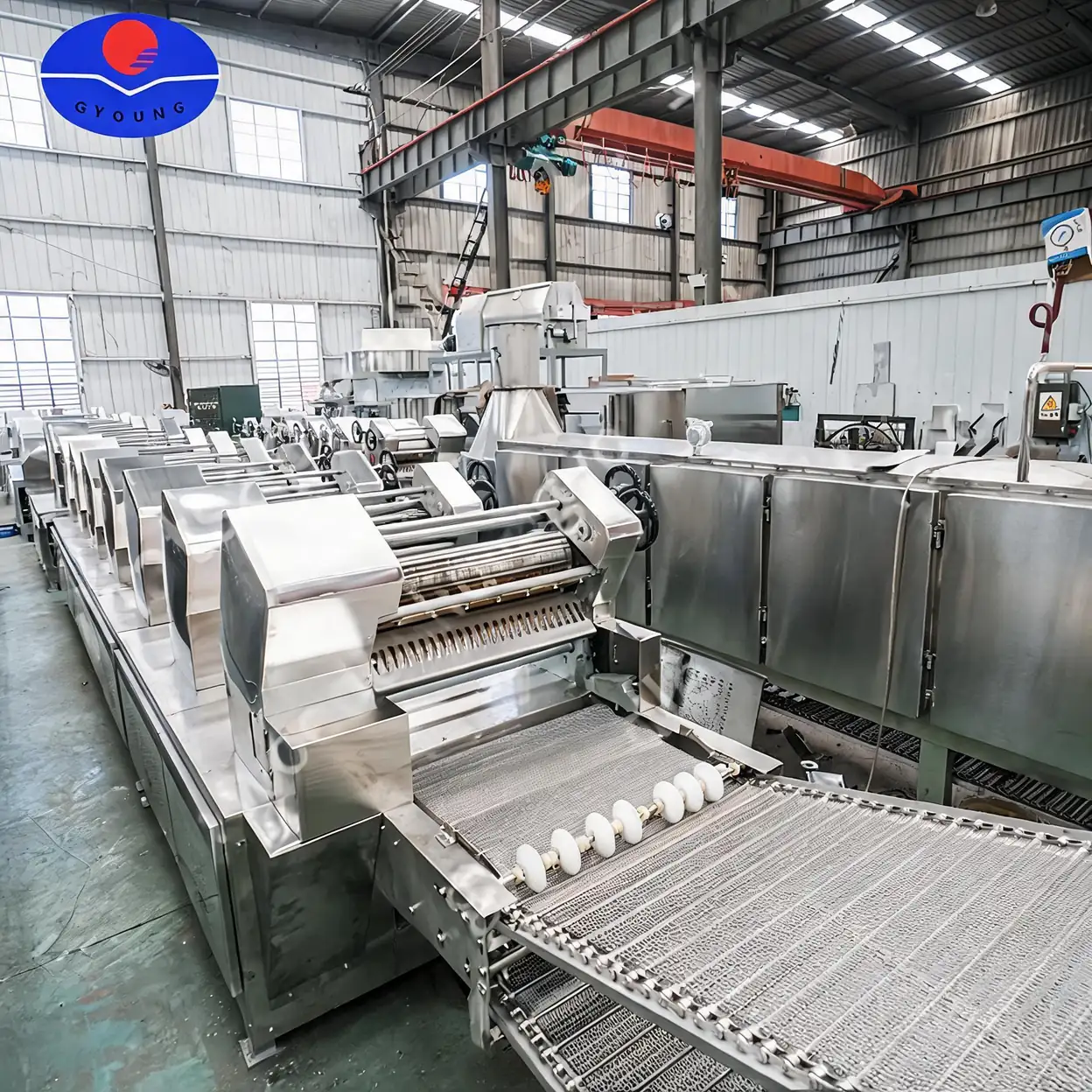
GYOUNG's modular production lines come pre-configured with all of these formulation flexibility features as standard. Each line is built with full 304 stainless steel food-contact surfaces — a critical requirement when processing grain blends that may have slightly higher natural acidity, which accelerates corrosion in standard steel equipment.
For context on line selection and factory setup, see our equipment selection guide for African markets and the complete factory startup guide.
6. Practical Implementation Guide — From Lab to Production
Developing a multi-grain formulation is not a one-step process. Here's a proven five-stage roadmap that takes you from ingredient sourcing to market validation.
Step 1 — Ingredient Sourcing
- Wheat flour: Specify medium-to-strong flour with 28–32% wet gluten content and 11–13% protein. Request a mill certificate showing gluten and falling number values.
- Sweet potato flour: Prefer pre-gelatinized (cold-water-soluble) grade. If unavailable, raw flour is usable with the steam pre-gelatinization adjustment described in Section 3.
- Vital wheat gluten: Food-grade, ≥75% protein, 80–100 mesh particle size. Order 1 kg sample lots from 2–3 suppliers for bench testing before committing to bulk purchase.
- CMC: Food-grade (E466), viscosity 800–1,200 mPa·s. Request a certificate of analysis showing purity and heavy metal levels.
- Soy flour & corn flour: Standard food-grade, low moisture (<12%), fine grind (80–100 mesh) for uniform distribution in the dough.
Step 2 — Lab-Scale Formulation Verification
Use a benchtop mixer to prepare 100–500g trial batches. Vary grain ratios from 12% to 20% in 2–3% increments, adjusting vital wheat gluten and water proportionally. Measure these five metrics per batch:
- Wet gluten content (hand-wash method or Glutomatic)
- Dough extensibility (subjective pull test)
- Sheet formation quality (visual check for tearing at ~1.5mm thickness)
- Cooking loss (boil 5 min, measure % solids in cooking water)
- Rehydration time (for instant noodle format)
Expect 3–5 rounds of iteration before the optimal ratio emerges.
Step 3 — Pilot-Scale Validation
Move to a small production line (20–50 kg batch size). Produce a minimum of 300 packs to obtain statistically meaningful data on:
- Sheet continuity through all calendering passes
- Post-frying crispness and oil content
- Rehydrated texture evaluation (chewiness, springiness, mouthfeel)
- Accelerated shelf-life testing (40°C / 75% RH for 7–14 days)
Step 4 — Gradual Scale-Up to Full Production
Do not jump from 10% grain to 17% in one shift. Use a progressive ramp:
- Start at 10% grain ratio → Run for 2–3 days, stabilize parameters.
- Increase to 14% grain → Run for 2–3 days, monitor sheet quality and oil uptake.
- Increase to 17% grain → Full target formulation. Document all parameter adjustments.
Step 5 — Market Validation
Before committing to full production volume, validate with blind taste tests (n ≥ 30 consumers), competitor product benchmarking, and packaging label compliance check against your target market's food regulations. The formulation is technically ready — market acceptance is the final gate.
7. Frequently Asked Questions
What is the minimum wheat flour percentage for producing quality instant noodles?
While 100% wheat flour produces the most consistent results, formulations can go as low as 70–75% wheat flour if supplemented with adequate vital wheat gluten (4–5%) and hydrocolloids like CMC. However, the 80% level offers the optimal balance of cost, quality, flavor differentiation, and process stability.
Can I use 100% sweet potato or corn flour for instant noodles?
Pure non-wheat flour instant noodles are technically challenging because these flours lack gluten entirely. Without gluten, the dough cannot form the continuous protein-starch network that gives instant noodles their characteristic texture. Commercial 100% sweet potato starch noodles do exist — popular in Korea as "japchae" noodles — but they follow a completely different extrusion-based process rather than the traditional calendering-and-steaming instant noodle process used for bagged and cup noodles.
How much does vital wheat gluten cost in bulk?
Food-grade vital wheat gluten typically costs $1,500–2,200 per metric ton in international bulk trade. At the 3% addition rate used in the 80/17 formula, it adds approximately $45–66 to the flour cost per ton of final product.
Can GYOUNG's production lines handle multi-grain formulations?
Yes. All GYOUNG instant noodle production lines are designed with adjustable calendering gap settings, variable steam temperature zones, and multi-zone drying profiles — all essential for handling diverse flour formulations including wheat, cassava, corn, sorghum, and sweet potato blends. Our engineering team also provides complimentary formulation optimization support during installation and commissioning.
Is CMC safe in food? What regulations apply?
CMC (Carboxymethyl Cellulose, E466) is approved as a food additive by the FDA (21 CFR 182.1745), the EU (E466), and CODEX Alimentarius. It is widely used in instant noodles at 0.1–0.5% levels to improve texture, reduce oil uptake, and extend shelf life. Always verify your target market's specific food additive regulations before finalizing your formulation.
Final Word
The 80% wheat flour + 17% multi-grain + 3% vital wheat gluten formulation offers something rare in food manufacturing — genuine product differentiation at par cost. The science is sound: wet gluten exceeds the 28% threshold with a comfortable safety margin at 30–32%. The economics are favorable: per-ton costs are virtually identical to the conservative 89% wheat formula, while the brand positioning opens doors to premium pricing, local content incentives, and a competitive moat that pure wheat noodles cannot replicate.
But formulation is only half the equation. The production line must be capable of flexing its parameters to accommodate the different hydration, mixing, and gelatinization behavior of multi-grain dough — and that requires equipment built with formulation flexibility as a design principle, not an afterthought.
Ready to develop your own multi-grain noodle formulation?
GYOUNG's engineering team provides complimentary formulation optimization as part of every production line purchase. Tell us about your target market and available local grains — we'll help you build a formula that differentiates your product and protects your margins.
Request Formulation Support →Or message us directly on WhatsApp for a same-day response.
References & Data Sources
- Mordor Intelligence. Instant Noodles Market Share Analysis, Industry Trends & Statistics, Growth Forecasts (2026–2031). June 2026.
- Mordor Intelligence. Global Pasta & Noodles Market Report. 2026. (Millet/ancient-grain category CAGR 7.21%)
- Dataintelo. High-Protein Noodles Market Size, Share & Trends Analysis Report 2034. April 2026.
- Food Navigator. Functional Health and Clean Label Trends in Convenience Foods. September 2025.
- Food Ingredients First. Global Clean Label Claims: 30% of New Products Carry No Additives/Preservatives Claim. May 2025.
- Gulia, N. & Khatkar, B.S. Relationship of dough thermomechanical properties with oil uptake, cooking and textural properties of instant fried noodles. Food Science and Technology International, 2015.
- Park, C.S. & Baik, B.K. Relationship Between Protein Characteristics and Instant Noodle Making Quality of Wheat Flour. Cereal Chemistry, 2004.
- Tan, H.Z., Li, Z.G. & Tan, B. Starch noodles: History, classification, and relationship to Asian traditional foods. Food Research International, 2009.
- ResearchGate. Effect of Carboxymethyl Cellulose on Instant Noodle Oil Uptake and Texture: A Review. 2025.
- Bulkfoods.com / Bakers Authority. Vital Wheat Gluten Product Specification: 75% Protein Content.
- WIPO Patent WO2008065104A1. Noodle With Improved Textural Properties Using CMC vs. Guar Gum. 2008.
- Deep Market Insights. Egypt Instant Noodles Market Analysis: CAGR 6.26% Through 2034. 2025.