1. The Middle East Opportunity: Why Saudi Arabia Stands Out
Saudi Arabia is the largest economy in the Gulf Cooperation Council (GCC) and, for food manufacturers, one of the most strategically interesting markets in the region. It is not just a domestic market: a factory in Saudi Arabia positions you to serve the wider Gulf and export into neighboring GCC markets.
Three forces converge here that most emerging markets don't offer at the same time:
- Demographics: a large share of the population is young and urban, with rising demand for convenient, affordable, ready-to-eat food.
- Halal by default: instant noodles produced to halal standards fit the local market without adaptation — a real advantage over non-halal competitors.
- Policy push: Saudi Vision 2030 and related programs actively encourage local food manufacturing to reduce dependence on imports, which creates a favorable environment for new production projects.
For a manufacturer already familiar with the Middle East's preference for strong flavors and lower-oil, well-seasoned noodles, this is a market worth serious evaluation.
2. Market Size & Demand Drivers
The GCC instant noodle market is part of a Middle East convenience-food segment that continues to expand, driven by population growth, urbanization, and a large expatriate workforce that depends on low-cost, fast meals.
| Metric | Figure | Note |
|---|---|---|
| Population (Saudi Arabia) | ~36–37 million | Majority urban, young median age |
| GCC economy | Largest in the Gulf | Saudi = anchor market for export |
| Demand driver | Convenience + halal + expat workforce | High per-capita ready-meal reliance |
| Policy tailwind | Vision 2030 local manufacturing | Import-substitution incentives |
The market is import-heavy today, which means meaningful room for a domestic producer to win share on price, freshness, and logistics — the same playbook that has driven local noodle manufacturing growth across Southeast Asia and Africa over the past decade.
3. Cost Structure & Investment Picture
For investors, the question is the same as everywhere else: what does it cost to set up, and how fast does it pay back?
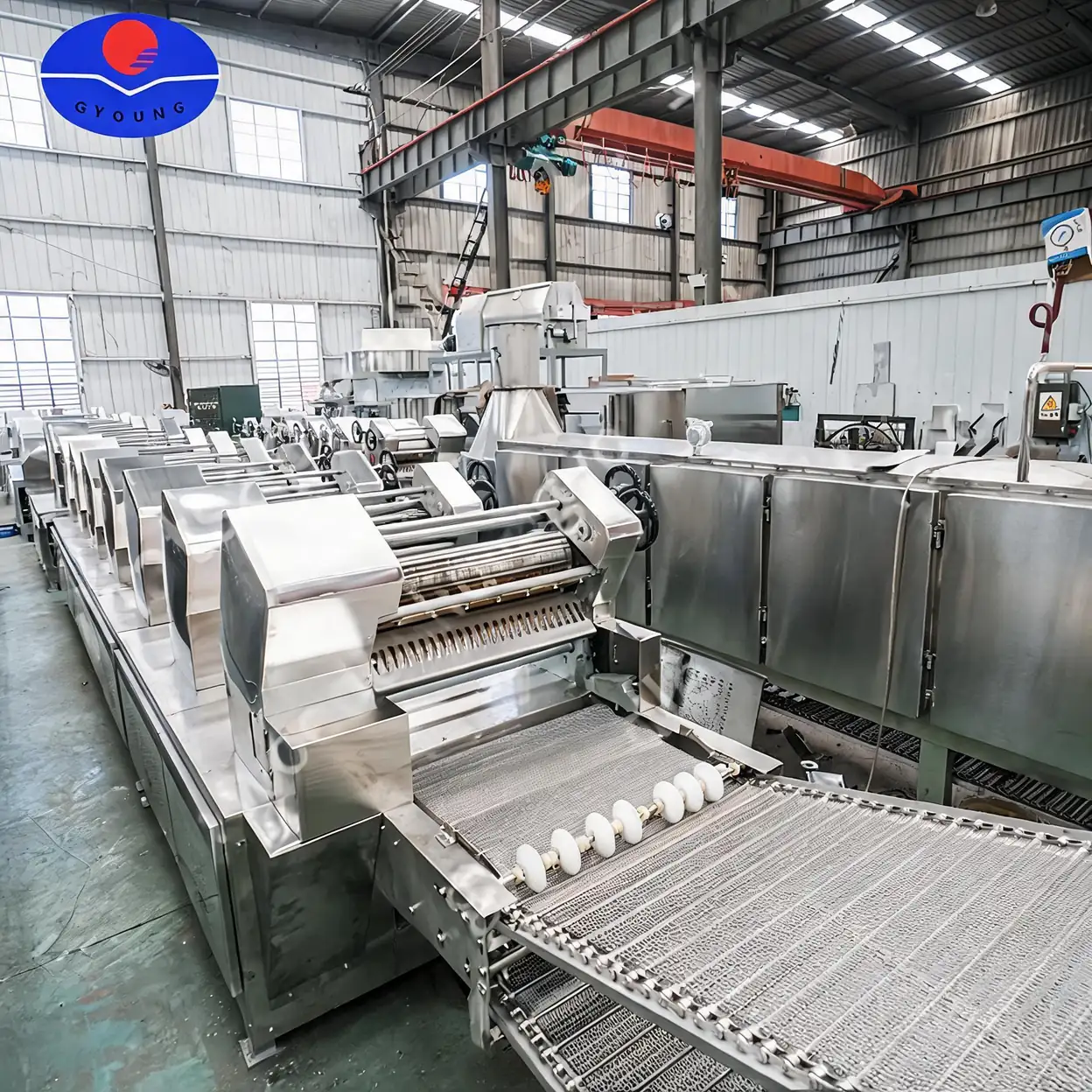
Equipment entry points are consistent with GYOUNG's standard line-up. An entry-level fried instant noodle line starts around $92,000–$96,000 FOB (excluding packaging machine), producing 30,000 packs per 8-hour shift with just 2–3 operators and a recommended plant footprint of about 15m × 40m. Higher-capacity configurations scale up to 300,000 packs per shift.
On lead time, plan a realistic full-cycle horizon:
- Manufacturing: about 3 months (90 days)
- Sea freight to Gulf ports: about 30–45 days
- Installation & commissioning: at least 1 month
- Total (order → first production): roughly 7 months
The more important economics hinge on operating costs. Saudi Arabia offers competitive energy for industrial users and a business environment designed to attract food manufacturing, but labor and raw-material costs should be modeled carefully — flour and palm oil remain the two largest input costs in any instant noodle operation regardless of market.
4. Halal, Certification & Compliance
For the Middle East market, compliance is not an afterthought — it is the entry ticket.
- Halal certification of both ingredients and the production process is expected across the GCC. A line built from 304 food-grade stainless steel and designed for cleanable, traceable production makes certification straightforward.
- CE and ISO 9001 remain the baseline international quality signals buyers look for in industrial equipment.
- Labeling must meet GCC (Saudi SFDA / SFDA.GCC) food labeling requirements, including Arabic labeling.
GYOUNG's lines are built with 304 stainless steel contact surfaces and come with CE and ISO 9001 certification, which supports both halal-audit readiness and importer due diligence in the region.
5. Is Saudi Arabia the Right Fit for Your Project?
Saudi Arabia is a strong fit for a specific, well-defined investor profile.
It suits you well if you:
- Want to serve the entire GCC from a single halal-compliant factory
- Prefer a market with policy support for local manufacturing rather than one fighting import taxes on finished goods
- Value certification and compliance as a competitive moat (halal + CE + ISO 9001)
- Have the capital and patience for a longer, more structured setup process (registrations, halal audit, licensing)
It requires more caution if you:
- Need a very fast, low-bureaucracy path to first production — the GCC setup process involves more formal steps than some emerging markets
- Depend on rock-bottom input costs — wheat and palm oil are imported, and energy/labor are competitive but not as low as South Asia or parts of Africa
Net net: Saudi Arabia rewards a patient, compliance-first operator with a premium, multi-country, halal-secured market — a different profile from the "cheapest possible cost" play that fits Nepal or parts of Africa.
Frequently Asked Questions
Is Saudi Arabia a good market for instant noodle manufacturing?
For a patient, compliance-first operator, yes. Saudi Arabia is the GCC's largest economy, its food economy is halal by default (so products fit the whole Gulf without reformulation), and Vision 2030 programs actively encourage local food manufacturing. The main trade-offs are a more structured setup process and import-dependent raw materials.
How much does it cost to start an instant noodle line for Saudi Arabia?
An entry-level fried instant noodle line starts around $92,000–$96,000 FOB (excluding packaging machine), producing 30,000 packs per 8-hour shift with 2–3 operators. Higher-capacity configurations scale up to 300,000 packs per shift. Add packaging equipment, shipping, and installation to reach a full project budget.
How long from order to production in the Middle East?
Plan roughly 7 months in total: about 3 months manufacturing, 30–45 days sea freight to Gulf ports, and at least 1 month for installation and commissioning. Halal certification, licensing, and SFDA labeling approvals run in parallel and should be started early.
What certifications does a noodle line need for Saudi Arabia and the GCC?
Halal certification of ingredients and process is expected across the GCC, along with Arabic labeling that meets SFDA/GCC food labeling rules. On the equipment side, CE and ISO 9001 are the baseline quality signals. GYOUNG lines use 304 food-grade stainless steel and carry CE and ISO 9001 certification, supporting halal-audit readiness.
What are the main costs of making instant noodles in Saudi Arabia?
As in every market, flour and palm oil dominate the per-pack cost, with seasoning, packaging, labor, and energy following. Saudi Arabia offers competitive industrial energy and a manufacturing-friendly business climate, but wheat and palm oil are imported — so procurement strategy and a climate-controlled storage plan are essential to protecting margin.
Planning a noodle production line for Saudi Arabia or the GCC?
Contact GYOUNG CHINA for a tailored line configuration, halal-ready equipment guidance, and a factory layout plan matched to your target capacity.
📩 Contact UsReferences / Data Sources:
- GYOUNG product & logistics documentation (2026) — line configurations (entry $92,000–$96,000 FOB, 30,000 packs/8h; up to 300,000 packs/8h), 2–3 operators, 15m × 40m recommended plant, and lead times (manufacturing ~90 days, sea freight 30–45 days, installation ≥1 month).
- Saudi Vision 2030 & SFDA (Saudi Food and Drug Authority) — national programs promoting local food manufacturing and import substitution; GCC/SFDA food labeling requirements including Arabic labeling.
- GYOUNG internal market research — Middle East Instant Noodle Opportunity (Sep 2026) — GCC demand drivers (young urban population, expatriate workforce, halal-first food economy), competitive landscape, and the import-substitution opportunity for domestic producers.
- World Instant Noodles Association (WINA) — regional and global instant noodle consumption context.
- GYOUNG quality/certification records — 304 food-grade stainless steel construction, CE certification, and ISO 9001 quality-management certification.
Related reading:
📌 Data Disclaimer: Market figures in this article — population, demand drivers, and market-size characterizations — are drawn from GYOUNG internal market research, public sources, and industry data and should be treated as directional estimates, not guarantees. Equipment prices, lead times, certification requirements, and raw-material costs cited reflect GYOUNG's standard product documentation and typical market conditions and may change. Halal, SFDA/GCC labeling, and licensing requirements should be confirmed with a qualified local compliance advisor. The payback and investment picture are indicative benchmarks — actual results depend on line scale, operational efficiency, procurement, and local execution. This article is for informational purposes only and does not constitute investment or legal advice.